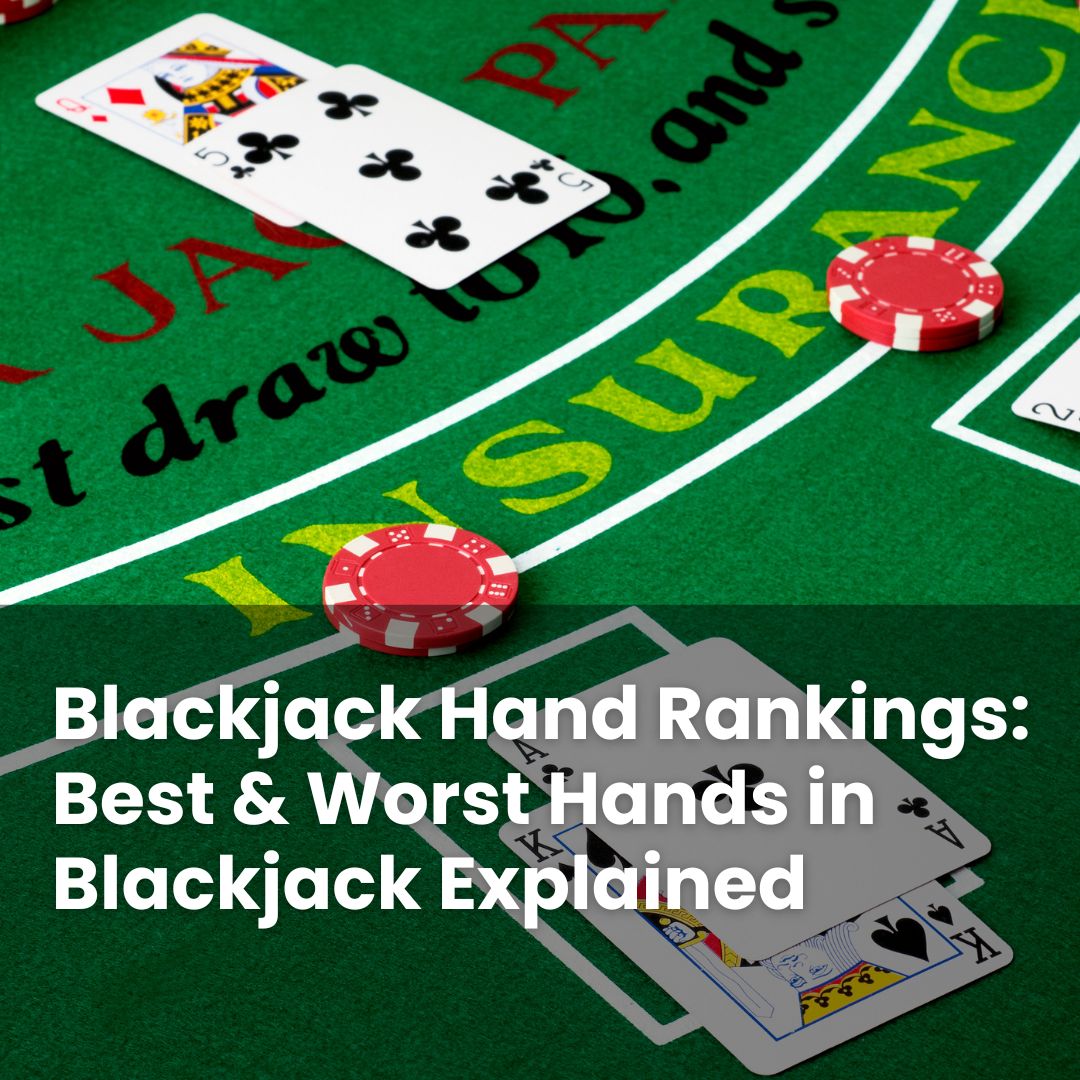
Understanding how blackjack hands are ranked is one of the first steps to developing a sound approach at the table. Knowing which hands are considered the strongest, and which are more challenging, can help players make more informed choices when faced with different cards.
Hand rankings in blackjack are more straightforward than in many other card games, but there are still key points to consider. Some hands offer better outcomes, while others may be more difficult to play. Recognising the difference can build confidence.
This blog post explores the strongest and weakest hands in blackjack, how hands are ranked, special hand types like the natural blackjack, and reasons why certain hands stand out.
Read on to learn more.
How Are Blackjack Hands Ranked?
In blackjack, hands are ranked by their total value, with the aim to reach a higher total than the dealer without going over 21.
Cards 2 to 10 are worth their face value. Face cards, which include kings, queens, and jacks, are each worth 10 points. An ace may be counted as either 1 or 11, depending on which value makes a better hand for the player.
The strongest possible hand is a natural blackjack, made up of an ace and any 10-point card in the first two cards dealt. Any hand that totals more than 21 is a bust and is the weakest outcome, as it loses automatically.
Hand strength is not affected by the suit of the cards. Only the total value matters. This keeps blackjack hand rankings simpler than other card games, but there are still differences between soft and hard hands that matter for decision-making.
Blackjack involves chance. While understanding hand rankings can guide decisions, results are not guaranteed, so setting personal limits is sensible.
What Is a Natural Blackjack and Why Is It the Best?
A natural blackjack occurs when a player’s first two cards add up to 21 points. This is achieved with one ace plus a card valued at ten (either a 10, jack, queen or king).
This hand is the strongest possible outcome in blackjack because it totals 21 in just two cards. In most games, a natural blackjack is usually paid at higher odds compared to other winning hands, such as 3:2, though some tables use different payout structures.
A natural blackjack also wins automatically unless the dealer also has a natural blackjack. In that case, it results in a push, meaning neither party wins or loses that round.
Having covered the top hand, it helps to look at other starting hands that often put players in a strong position.

Discover The Best Online Casinos
Browse our list of top-recommended casino sites, read reviews from real players & be the first to get access to the latest casino bonuses
Strong Hands in Blackjack
Some hands in blackjack are viewed as stronger starting points than others. These hands give a player a firmer footing against the dealer, even though the result of any round can still vary.
Soft 20 and Soft 21
As mentioned earlier, soft hands contain an ace that can be valued at 11 or reduced to 1 if needed. A soft 20 is an ace with a nine, while a soft 21 is an ace with a ten-value card.
Soft hands are useful because the ace’s flexible value can absorb one extra card without an immediate bust. For example, a soft 20 that draws a small card can settle at a strong total, while a large card simply converts the ace to 1. That safety net is what makes soft 20 and soft 21 particularly strong positions against the dealer.
Paired Aces and Paired Eights
Paired aces and eights are notable starting pairs. Two aces can be split into two separate hands, each beginning with an ace, which introduces more ways to reach a high total. This is why aces are often seen as the most valuable pair to divide.
Eights are different but important for a similar reason. Two eights total 16, which is a difficult number to play as a single hard hand. Splitting them converts one awkward total into two new hands that have a better chance to improve.
Not every start is so forgiving, though. Some hands are difficult from the moment they are dealt.
What Are the Worst Hands in Blackjack?
Certain hands are less favourable because they put the player under pressure against the dealer.
The weakest outcome is any hand that totals more than 21, known as a bust. Once a player goes over 21, the hand automatically loses, regardless of the dealer’s cards.
Hard totals between 12 and 16 are also challenging. Drawing another card risks going beyond 21, but standing can leave a player trailing if the dealer builds a stronger total. Without an ace acting as 11, these hard hands lack flexibility and often feel uncomfortable to navigate.
Why Hard 12 To 16 Are Risky Hands
Hard hands totalling 12 to 16 are risky because they sit in a narrow zone where both main choices carry drawbacks. Taking another card comes with a meaningful chance of going over 21, yet standing keeps a relatively low total that the dealer can often beat.
The dealer finishes their hand after all players have acted. That order matters. A player who busts loses immediately, even if the dealer later goes on to bust as well. This dynamic makes middling hard totals particularly costly when they tip over 21.
Which option feels stronger can depend on the dealer’s face-up card and the specific table rules, but the tension in these totals largely comes from simple arithmetic: the higher the hard total, the more ranks will push it past 21 if another card is drawn.
How Do Soft and Hard Hands Affect Your Ranking?
Whether a hand is soft or hard changes how safely it can be developed. A soft hand, with an ace counted as 11, can usually take one more card without an immediate bust because the ace can drop to 1. That extra room to manoeuvre can turn a borderline spot into a comfortable total, as with a soft 18 improving to 19, 20 or 21.
A hard hand either has no ace or must treat the ace as 1 to avoid exceeding 21. Without that safety valve, drawing can be riskier and standing can feel conservative. This difference is why two hands with the same total can have very different practical strength: soft 18 plays quite differently to hard 18.
How Do Dealer Rules Affect Hand Strength?
The dealer’s actions are set by fixed rules, which shape the outcome of each round and influence how strong a player’s total really is in context.
The most common rule is that the dealer must draw until reaching at least 17. At some tables the dealer stands on all 17s, while at others the dealer must take another card on a soft 17. When the dealer hits a soft 17, their average final total is slightly higher, which can make marginal player totals such as 17 or 18 fare worse than they would on a table where the dealer stands.
Dealers do not make discretionary choices. They follow house rules every time, removing human error and keeping outcomes consistent from round to round.
Understanding the rules helps set expectations for a given table. But how often do the top and tricky hands show up in the first place?
What Are the Probabilities of Top and Bottom Hands?
Blackjack hands are dealt at random, so the odds of getting any particular hand depend on the number of decks used and which cards have already been dealt.
A natural blackjack, made with an ace and a 10-value card as the first two cards, is relatively rare. In a typical single-deck game, the probability of being dealt a natural blackjack is just under 5%. Hands totalling 20 are a little more common, though still far from frequent.
At the other end, no two-card hand can bust straight away. The risk appears when more cards are drawn, and it rises with higher hard totals. As a simple guide with a fresh deck, taking one extra card will bust:
- Hard 12 about 31% of the time
- Hard 13 about 38% of the time
- Hard 14 about 46% of the time
- Hard 15 about 54% of the time
- Hard 16 about 62% of the time
These numbers are approximations, but they show why middling hard totals feel uncomfortable and why soft hands offer more breathing room. With the maths in mind, it is also worth clearing up a few common myths.
Common Misconceptions About Blackjack Hand Strength
There are several misunderstandings about what makes a hand strong or weak in blackjack. One common belief is that a hand with a total value close to 21 will always win. The outcome also depends on the dealer’s hand and the house rules, so no hand is guaranteed to succeed.
Another misconception is that suits play a role in hand strength. In blackjack, only the total value of the cards matters; the suits have no impact on the outcome.
Some players also think that a winning approach relies on rigid rules alone. While structured strategies can inform decisions, blackjack always includes an element of chance, and even the most consistent approach will still see losing rounds.
It is also sometimes believed that a loss in one round means a player is due for a better hand in the next. Each round is independent, and the outcome of one game does not influence the next.
If you choose to play blackjack, never wager more than you are willing to lose. Set personal limits that suit your circumstances and take regular breaks. If gambling starts to affect your well-being or your finances, seek support early. Independent organisations such as GamCare and GambleAware offer free, confidential help for anyone who needs it.
Understanding how hands are ranked is just one part of staying informed and keeping play in perspective.