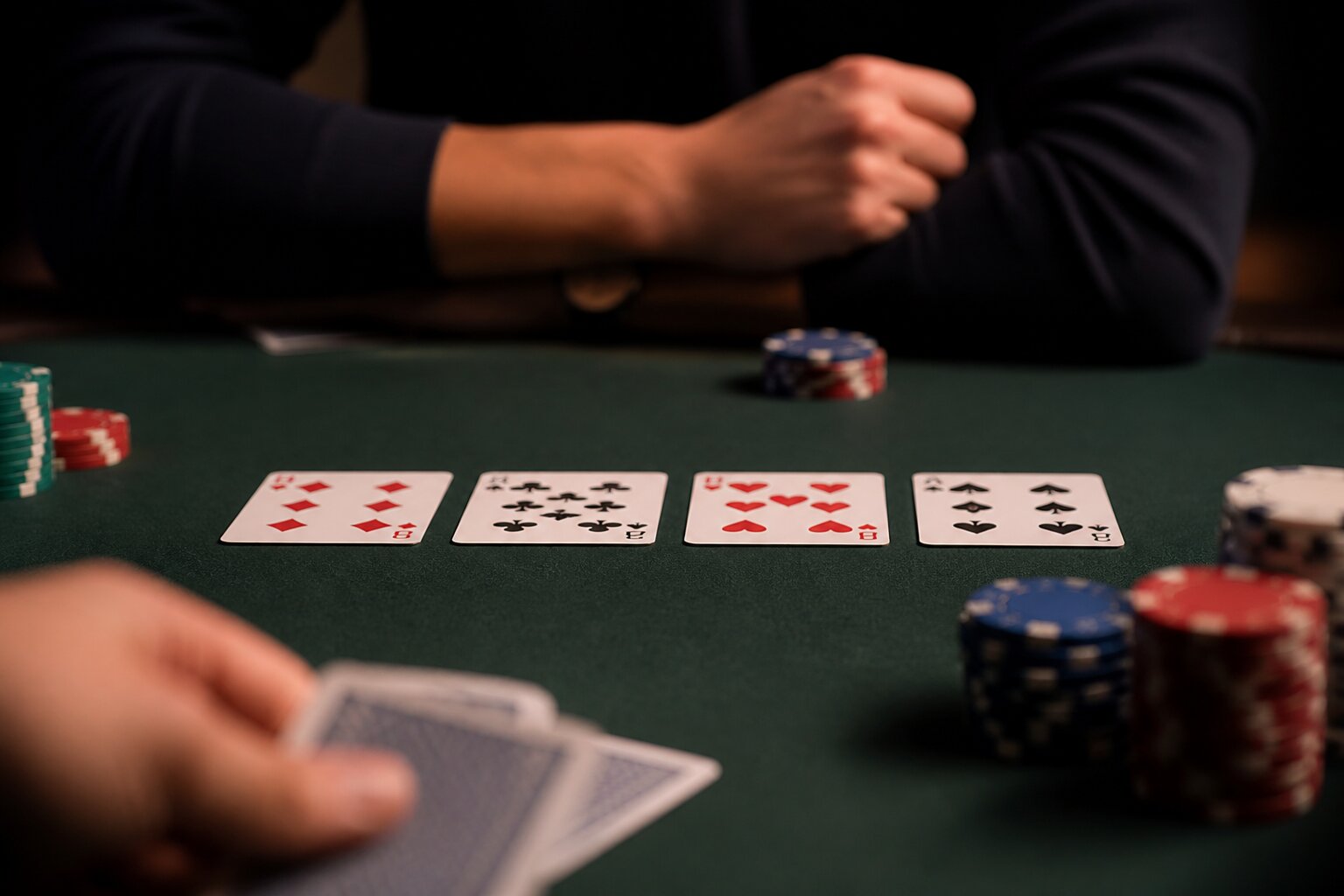
Poker is about more than the two cards in your hand; it’s about how the shared cards on the table change the contest between players. The flop, turn and river reveal information in stages, and each new card can change what the best hand looks like and how players behave.
Whether you are new to the game or refreshing the basics, understanding these stages helps you read situations and make better choices. Read on to see how each moment at the table alters the options available to every player.
What Are Community Cards in Poker?
Community cards are the face-up cards dealt in the centre of the table that every active player may use when forming a five-card poker hand. They contrast with hole cards, which are private and only seen by the player who holds them.
In formats such as Texas Hold’em and Omaha, the community cards create a common set of possibilities. Players combine their hole cards with the board to build the best hand they can, which introduces strategic interaction: you must judge not only your own potential but the likely combinations other players might have.
Because the same cards are available to all, reading how the board interacts with various holdings is central to sound play. The stages that follow show how those interactions evolve and why each one invites a different kind of decision.
The Flop: Introducing the First Three Community Cards
The flop is the moment when the first three community cards are dealt face-up after the opening betting round. It often reshapes the hand by giving players a clearer idea of what hands are possible and how strong their own holdings might be.
Once the flop is visible, players reassess. The board can complete draws, pair the board, or present coordinated cards that favour certain ranges of hands. Betting here can be cautious or aggressive depending on position, the texture of the flop and what opponents’ actions have suggested.
Reading flop texture—whether the cards are connected, suited or paired—helps guide decisions on the turn. With that in mind, the next section explains how a single additional card can change the game again and how to adjust accordingly.

Discover The Best Online Casinos
Browse our list of top-recommended casino sites, read reviews from real players & be the first to get access to the latest casino bonuses
What Is the Turn and How Does It Affect Poker Hands?
The turn is the fourth community card, dealt after a second betting round. It brings fresh information and often narrows the plausible holdings for each player by either completing draws or making them less likely.
When the turn appears, its relationship to the flop and players’ previous actions shapes the betting. A card that completes a straight or flush draw will usually prompt more cautious responses from players whose hands have been overtaken, while one that does not help may be treated as a blank that nonetheless changes pot odds and strategic incentives.
Because the turn reduces uncertainty more than the flop does, it is frequently a decisive moment for weighing risk against the potential reward of continuing. The river that follows is the final reveal and will be where final calls or folds are determined.
The River: Final Community Card and Its Impact
The river is the fifth and final community card and completes the shared board. With all five community cards dealt, players can see the full range of combinations and decide how to act in the last betting round.
At this stage, the river can confirm earlier lines or produce surprising results by completing previously unseen hands. Betting tends to be more polarised: some players will make strong value bets while others will choose to fold when their chances of improving have vanished. Evaluating the river requires considering how the action unfolded on previous streets and whether opponents’ lines represent strength or bluff.
With the hand concluded after the river betting, reflecting on how the board developed across the flop and turn helps improve future decision-making.
How Do Community Cards Shape a Poker Hand?
Community cards combine with private hole cards to form the final five-card hand. In Hold’em, that means blending any two private cards with the five on the board; in Omaha, players must use two of their four hole cards together with three community cards.
This interplay determines the relative strength of each player’s hand. A dry board that is uncoordinated and unsuited tends to favour high-card and pair hands, while a connected or suited board creates many drawing possibilities and makes stronger hands more common. Recognising these patterns allows a player to judge not just what they hold but what others might have, and to size bets and calls accordingly.
Drawing to improve a hand often involves calculating outs and pot odds to decide whether continuing is worthwhile. The clearer the board becomes, the more information is available to estimate the probability of improvement and the likely responses from opponents, shaping strategic choices at each stage.
Ranking Possible Hands
Poker hands are ranked from high card up to royal flush. Familiarity with the hierarchy helps assess relative strength quickly as the board develops. For example, a paired board increases the chance of full houses, while two suited cards on the flop open the possibility of flushes by the river.
Understanding which hands are plausible on a given board allows a player to interpret betting patterns and to choose lines that either extract value or protect a marginal hand.
Drawing to Improve Your Hand
A draw describes a hand that requires specific future community cards to become strong—for example, needing one card for a straight or two cards for a flush. When contemplating a draw, comparing the number of outs to the size of the pot helps determine whether the potential reward justifies continued investment.
Players also account for the likely holdings of opponents and how the remaining cards could complete competing draws. This strategic weighing of possibilities is central to making measured choices through to the river.
Why Do the Flop, Turn, and River Matter in Decision-Making?
Each community-card stage provides new information and a fresh decision point. The flop narrows possibilities, the turn sharpens them further and the river delivers the final picture. Players adjust tactics as the board evolves, weighing pot size, position, and opponents’ behaviour.
Because betting opportunities occur after each reveal, managing one’s involvement and bankroll depends on adapting to changing circumstances rather than sticking rigidly to a single plan. Thoughtful decisions on these streets help avoid overly costly calls and enable extracting value when holding the best hand.
Next, we address some misconceptions that can cloud judgment and lead to poor choices at the table.
Common Myths About Community Cards
Several misconceptions persist about how community cards work and how they affect play. One is that certain seats or recent results influence what community cards will appear; in reality, each deal is independent and the board is the same for every active player.
Another myth is that patterns seen over a short period can be used to predict future boards. The shuffle and deal prevent reliable prediction, so relying on perceived streaks is unhelpful. Similarly, the idea that memorising small samples of previous boards gives a practical edge is misleading because random distribution and shuffling dominate outcomes.
Recognising these myths helps maintain a fact-based approach to decision-making and avoids misjudging opponents or the situation. With a clear grasp of how the board evolves, players are better prepared to evaluate hands and respond effectively on later streets.
Flop
The flop is the first three community cards dealt face-up in the centre of the table after the opening round of betting.
Turn
The turn is the fourth community card dealt face-up, following the flop and a second round of betting.
River
The river is the fifth and final community card revealed after the turn and an additional betting round, completing the shared set of cards.
Hole Cards
Hole cards are the private cards dealt face-down to each player at the start of the hand; these are not shared with other players.
Board
The board refers collectively to all community cards on the table once they have been dealt.
Draw
A draw is a situation where a player needs a specific community card or cards to improve their current hand, such as drawing to a straight or a flush.
Knowing these terms smooths the learning curve and makes in-game discussion clearer. Play that is informed by the stages of the board and by realistic assessments of opponents tends to be stronger and more consistent.
Play within clear personal limits and choose operators that prioritise player protection if playing online. With the concepts above understood, you can approach tables with a better sense of how each community card changes the contest and what decisions each stage invites.