Ever wondered how many decks of cards are actually used in poker? It’s a simple question, but the answer isn’t always as straightforward as it seems.
Different game types and settings can change how the cards are handled, and knowing what to expect makes it easier to join a table with confidence. Read on to understand the deck setups behind common poker variants, when more than one deck might appear, and what that means for play.
Understanding the Standard Poker Deck
A standard poker deck contains 52 playing cards divided into four suits: hearts, diamonds, clubs and spades. Each suit has thirteen ranks, from 2 up to ace. In most poker games the full 52-card set is used and jokers are not part of play.
The uniform structure of the deck supports consistent odds and familiar hand rankings across variants. Cards are manufactured with clear faces and back designs so they can be easily identified by players and the dealer while remaining secure against tampering. This basic setup underpins nearly every standard poker game you will encounter, whether at home, in a club or online.
How Many Decks Are Used in Popular Poker Variants?
Most poker variants you see in cash games, tournaments and online platforms use one 52-card deck. That includes the widely played formats discussed below. Using a single deck keeps the possible hand combinations predictable in the sense that everyone at the table is operating from the same known pool of cards.
This single-deck approach also simplifies shuffling and dealing, and it keeps the game consistent so players can apply the same hand probability knowledge across different games. The next sections explain how that applies in specific variants and settings.
Texas Hold’em: Deck Size and Reasoning
Texas Hold’em is played with one standard 52-card deck. All players receive the same potential pool of cards, with the shared community cards forming the centrepiece of the action. That single-deck structure preserves the familiar probabilities behind hand strength and strategic choices, which is why it is the norm in cash games and tournaments alike.
Omaha and Stud: What Decks Are Used?
Omaha and Seven Card Stud also use one 52-card deck. Omaha gives each player four private cards with five community cards, while Seven Card Stud involves individual up and down cards without community cards. Despite the different mechanics, both variants rely on the same single-deck foundation so players can compare hand odds and strategies across formats.
Casino vs Home Games: Does Deck Count Differ?
In most organised settings and serious home games, the expectation is one deck per table. Some home groups do introduce house rules for fun, but it is very uncommon to play poker with more than one deck in active use for a single hand. In commercial or public events dealers may have spare decks at the ready simply to speed up table turnover; only one deck is used for any given hand.
If you want to check how a specific operator or venue runs games, look for their game information or rules page. That will usually explain how dealers handle decks and whether any non-standard rules apply.

Discover The Best Online Casinos
Browse our list of top-recommended casino sites, read reviews from real players & be the first to get access to the latest casino bonuses
Why Do Some Poker Games Use More Than One Deck?
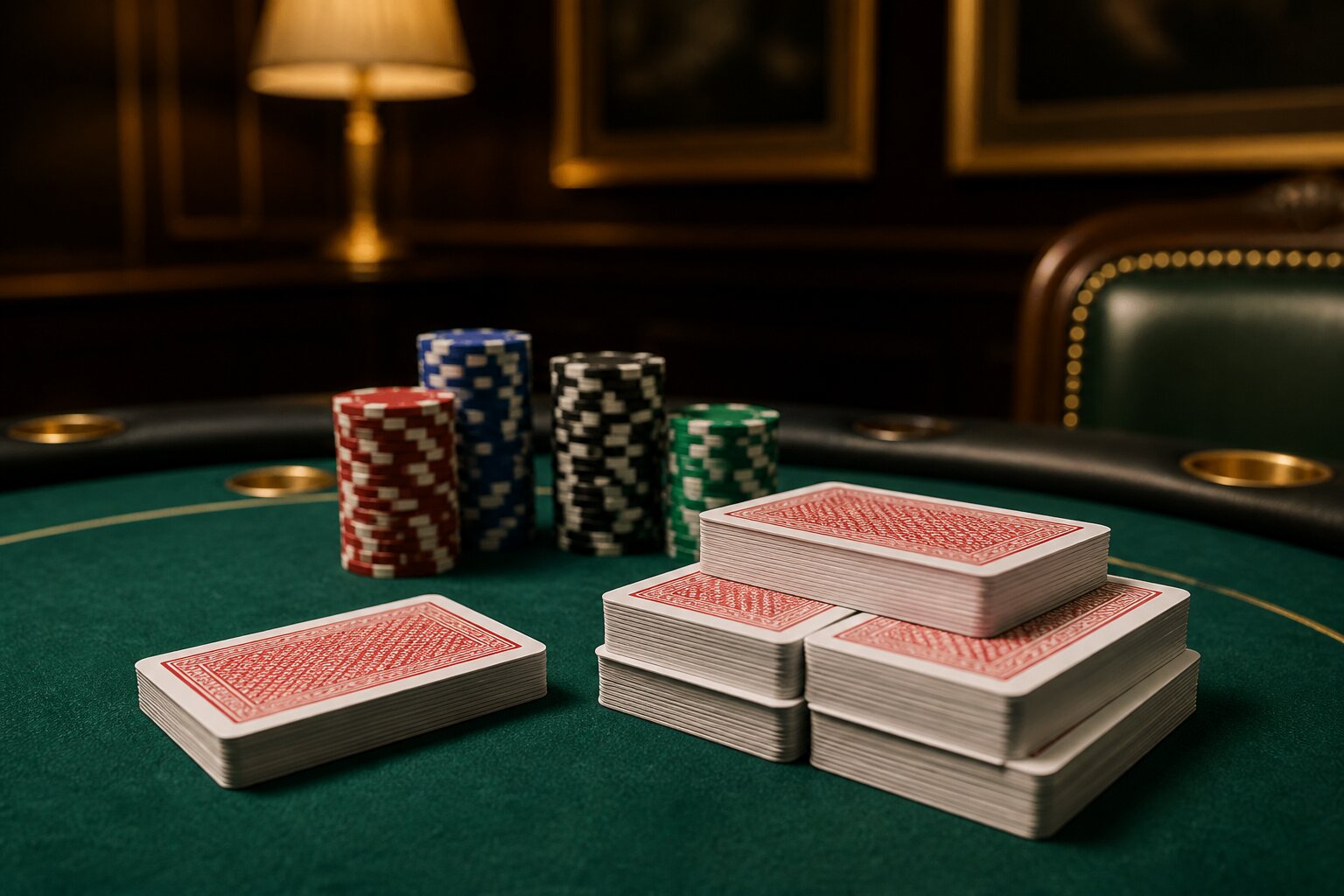
Multiple physical decks sometimes appear at tables, but they are used as an operational convenience rather than to change the game. In busy rooms a dealer will keep a second deck shuffled and ready to swap in between hands to reduce delays. The game itself still relies on a single deck to determine cards for each hand.
Occasionally a casual home game might experiment with jokers or extra decks for novelty, but that alters probabilities and hand possibilities and is not typical of standard play. When non-standard decks or wild cards are introduced the host should explain the adjustments so everyone understands how the game will differ.
Deck Variations and Their Impact on Gameplay
Altering the deck by adding jokers or extra cards changes the potential hand combinations and therefore the odds of particular outcomes. For example, introducing jokers as wild cards increases the variety of possible hands and can make strong combinations more common than they would be in a 52-card game. That affects strategy because players must account for a different distribution of plausible hands.
When rules adjust the deck or add wild cards, transparent communication is important. Knowing the exact configuration before play begins allows players to adapt their tactics and expectations without surprises. The following section tackles myths that often arise around deck use, which should help clarify what is standard and what is not.
Common Myths About Decks in Poker
A frequent myth is that multiple decks are used in play to make games less predictable or to favour certain outcomes. In standard poker this is not the case; a single 52-card deck is the norm. Another misconception is that extra decks or jokers give players any particular advantage. Changes to the deck do alter probabilities, but they affect everyone at the table equally rather than offering a private benefit.
Some players also think that jokers are commonly part of regulated play. In regular variants and organised events jokers are usually excluded unless a game is explicitly described as a wild-card variation. Clear rules from the host or operator should resolve any doubt, so look for those details when joining a game.
If you need help finding operators or venues that explain their rules clearly, consult our lists and comparisons for straightforward guidance.
What Should Players Know When Joining a Poker Game?
Before joining a table, confirm the game variant and any specific house rules, including whether jokers or other alterations are in use. Understanding the deck configuration and how the dealer manages cards will help you make informed decisions and participate with confidence.
Set personal limits and be mindful of the stakes and structure of the game you are entering. Knowing the format and deck setup supports sensible play, but does not change the inherent uncertainty of card distribution. Play within your means and choose games where the rules and deck treatment are openly communicated.
With those points clear you will be ready to take your seat and focus on the strategy of the hand at play.