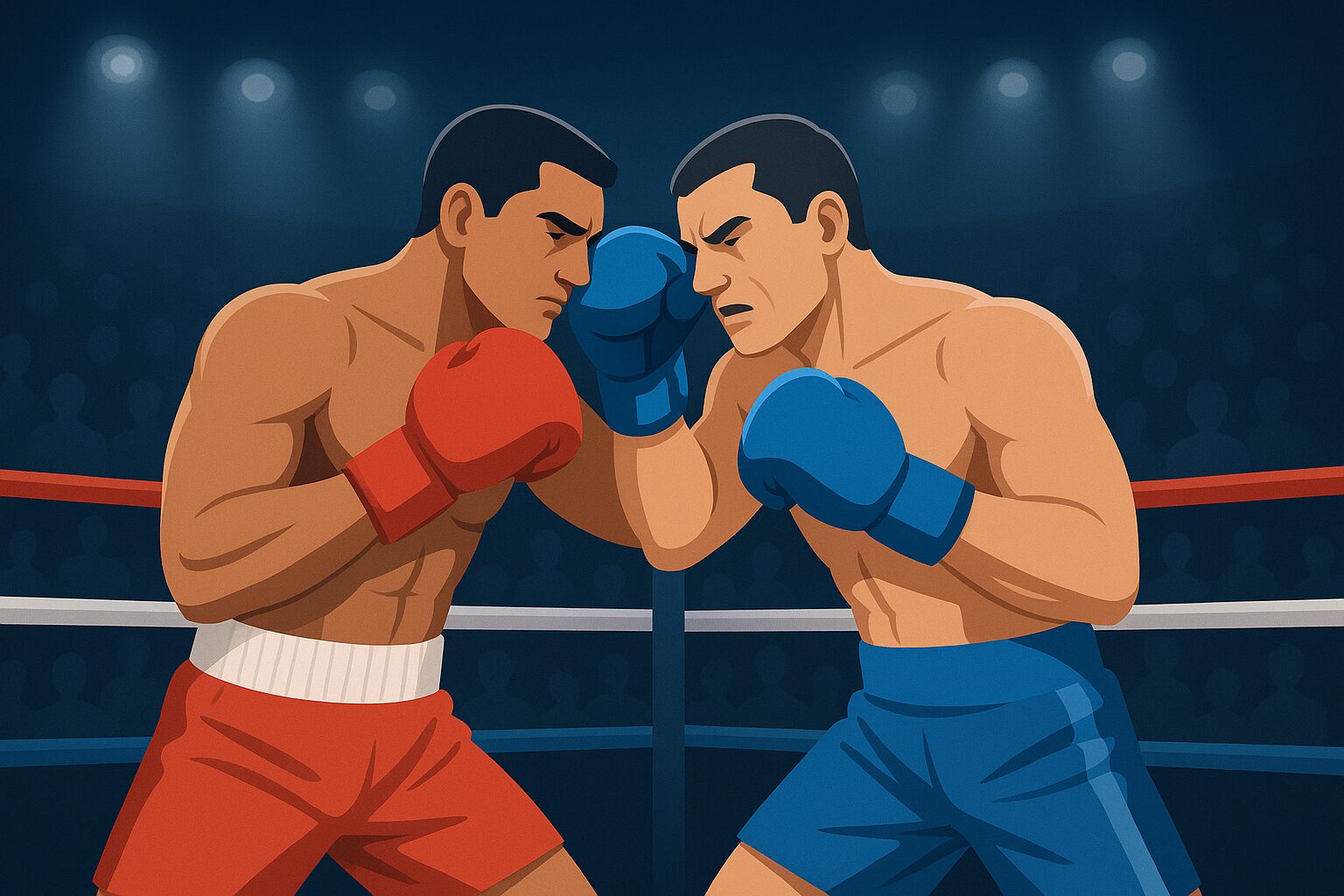
Ever wondered how long a boxing match actually lasts, or which bout went on the longest? Bell to bell, there’s a clear structure behind every contest, and once you know it, the timings all make sense.
If you’re following the sport or weighing up a bet, understanding rounds, breaks and stoppages helps you read a fight properly. It won’t give you an advantage, but it will make the action easier to follow. Always set limits and gamble responsibly.
Keen to see how modern timings compare with the sport’s epic marathons of old? Our guide below walks you through today’s formats, historical outliers and the safety rules that shape them.
How Many Rounds Are There in Boxing?
The number of rounds depends on whether the bout is professional or amateur. In professional boxing, championship fights are scheduled for 12 rounds, each three minutes long, with one-minute breaks. Many non-title bouts are shorter, typically 4, 6, 8 or 10 rounds, set by the promoter and commission. In most jurisdictions women’s professional title fights are 10 two-minute rounds.
Amateur contests are usually shorter. Most adult amateur bouts run for three rounds of three minutes. Youth or novice competitions often use two-minute rounds to suit developing experience and fitness. Timings can vary by governing body and age group, with one-minute rests between rounds.
Not every fight goes the distance. Knockouts, technical knockouts, injuries, disqualifications or a corner stopping the fight can all bring an early finish. Referees or doctors may halt a bout on safety grounds. If an accidental clash ends a fight after a set number of rounds, officials can use the scorecards for a technical decision; if it happens earlier, it may be a technical draw or no contest.
How Long Does Each Boxing Round Last?
In professional boxing, a round lasts three minutes, followed by a one-minute break for recovery, tactical advice and any cut work from the corner team. Most women’s professional contests are scheduled for two-minute rounds with the same one-minute interval.
Amateur timings vary slightly. Adult amateurs commonly box three-minute rounds at international level, while many youth and some women’s competitions use two-minute rounds to balance intensity with safety and pacing.
Exact timings are set by the sanctioning body and event rules, so formats can differ from card to card. Rounds begin and end on the bell.
What Affects the Duration of a Boxing Match?
Plenty of in-ring events can shorten a bout. A knockout ends things immediately if a boxer cannot beat the referee’s count of ten. A technical knockout can be called when the referee, ringside doctor or a corner judges a fighter unable to defend themselves safely, often due to heavy unanswered shots, a badly swollen eye or a nasty cut that compromises vision.
Other early endings include disqualifications for serious fouls or a retirement on the stool between rounds. Accidental fouls can also play a part. A clash of heads that causes a cut may see the contest halted, with the outcome decided on the scorecards if enough rounds have been completed, or ruled a no contest if it is stopped too early to judge fairly.
If none of these occur, the fight runs to the final bell and goes to the judges’ scorecards. How quickly that final bell arrives can still vary, as round lengths and formats differ. Most professional men’s bouts use three-minute rounds, while many women’s contests use two-minute rounds, and title fights are often scheduled for more rounds than non-title bouts.
Styles and tactics heavily influence how long a match lasts in practice. High-pressure fighters who close distance and throw in volume are more likely to force a stoppage than cautious counter-punchers who prefer to slow the pace and pick moments. Frequent clinching, larger rings that favour movement, and opponents feeling each other out can all extend how long a bout takes to reach its conclusion.
External factors can pause the action without ending the fight. The referee may stop the clock to replace a dislodged mouthguard, retape loose gloves, give time to recover from a low blow within the rules, or bring in the doctor to check a cut. These interventions add real-world minutes even when the scheduled number of rounds does not change.
Given all that, two contests scheduled for the same number of rounds can finish at very different times.
Professional vs Amateur Boxing: How Do Durations Differ?
Professional bouts tend to be longer. World title contests are set for 12 three-minute rounds, while earlier career fights can be 4, 6, 8 or 10 rounds. The longer format allows strategies to develop over time, with pacing, feints and body work often building across the middle rounds. Some non-title main events also run 12, though many are set for 10, and women’s title fights are generally 10 two-minute rounds; any contest can end early via knockout, technical stoppage or a corner retirement.
Amateur boxing is designed for shorter, sharper contests. Most adult amateur matches are three rounds of three minutes, and youth or novice bouts often use two-minute rounds. The structure encourages clean, effective scoring and prioritises safety for less experienced boxers. Referees can stop a contest early if one boxer is outclassed, and because tournaments may run across several days the shorter format helps manage fatigue.
These different aims explain the contrasting tempos you see on fight night. Amateurs typically start fast and keep a brisk work-rate, while professionals manage the pace, invest in body shots and look to create openings as the rounds unfold.
What Is the Longest Boxing Match Ever?
Boxing’s early days produced some extraordinary marathons. The longest on record took place in 1893 in New Orleans, when Andy Bowen and Jack Burke boxed 110 rounds over more than seven hours. With both men exhausted and unable to continue, the contest was declared a no contest.
Held at the Olympic Club on 6 April 1893, the bout ran through the night as the pair worked through three-minute rounds with a minute’s rest between each. Contemporary reports describe both men as utterly spent by the closing stages, with Burke said to have damaged his hands and Bowen repeatedly hauled back to his corner.
After 110 rounds, there was no knockout and officials declined to award a decision. The referee called it off in the early hours, leaving the crowd to file out having witnessed a record that modern rules make virtually impossible to match.
What Led to the Longest Boxing Match?
At the time, regulations were looser and time limits less strictly enforced. Many contests were scheduled to a finish rather than over a fixed number of rounds, and judges’ scorecards were not uniformly in place. With no modern cap on total rounds and safety stoppages applied differently, the bout continued until neither fighter could go on. Today’s rules would have halted a contest long before reaching such extremes.
Modern oversight avoids these scenarios, capping rounds and empowering referees and doctors to act quickly when needed. Title fights are limited to 12 rounds, pre and post-fight medicals are standard, and commissions can impose medical suspensions. These safeguards, along with ringside doctors and clearer criteria for stoppages, keep duration within strict bounds and prioritise the boxers’ welfare.
Does Weight Class Influence Match Length?
Weight class does not change the official number of rounds or the length of each round. A heavyweight title fight and a flyweight title fight share the same timing framework, set by the sanctioning body and event. Any timing changes are about championship status or local regulations, and they apply across all weights.
Where you notice differences is in tempo and tactics. Heavier divisions may feature fewer, heavier shots that can produce stoppages, while lighter divisions often show faster movement and higher output. Bigger athletes may conserve energy, whereas smaller ones build pressure with volume.
These contrasts shape whether bouts end early or go the distance, but not the schedule.
Can Boxing Matches End Before the Scheduled Time?
Yes. A KO ends a fight if a boxer fails to rise before the count of ten. A TKO can be called by the referee, doctor or corner when a fighter cannot safely continue, whether due to sustained punishment, a significant cut or an injury. The corner may also throw in the towel to signal a stoppage.
Disqualifications for serious fouls also end bouts, and a boxer can retire between rounds if they or their team decide not to continue. Accidental head clashes can also prompt a technical decision or a no contest, depending on when the bout is stopped. This range of outcomes is why even short scheduled fights can finish sooner than expected.
How Is Stoppage Time Handled in Boxing?
Stoppages are decisive. If a knockdown occurs, the referee administers a count. Failure to meet the count ends the fight immediately. If the referee deems a boxer unfit to continue, it is a technical knockout. For cuts, injuries or an inability to defend, the referee can pause the action to consult the doctor, then either restart or stop the bout.
There is no added time to make up for interruptions. The timekeeper pauses the clock during official time-outs, but no extra time is awarded. The official result records the round and second at which the stoppage occurs, whether that is 1 minute 12 seconds into round 3 or at the bell ending round 8.
Does the Length of Matches Impact Boxer Safety?
Yes. The longer a contest runs, the greater the cumulative fatigue and the higher the potential for damage. That is why modern boxing limits professional bouts to a maximum of 12 three-minute rounds and sets amateur timings even lower, with medical checks before, during and after events.
Referees and ringside doctors are empowered to stop a fight at any moment to protect a boxer’s wellbeing. Those safeguards, along with clear round limits, define how long matches can last today.
If you want to see how a specific card is structured, check our latest fight schedules and rules breakdowns. And if you choose to bet, set a budget, stick to it and enjoy the sport responsibly.