Ever wondered what’s really happening behind those spinning reels? For many, slots are the most popular games in a casino, but few people understand the technology and rules that determine each result.
With so many flashing lights, catchy sounds and the chance of a big payout, it’s easy to focus on the surface. Understanding what sits beneath the display — the software, the regulation and the maths — gives a clearer idea of how outcomes are produced.
Below we explore the design of modern machines, the role of Random Number Generation, how outcomes and payouts are formed, and what the numbers shown to players actually mean. First, let’s look at how today’s slots are put together.
How Are Modern Slot Machines Designed?
Modern slot machines are much more than their eye-catching graphics and soundtracks. Today, nearly all slots are digital, driven by computer software rather than mechanical gears. That software not only controls the reels but also the animation, timing and the way wins are displayed.
Developers design every element — symbol frequency, animation speed, bonus features — to work together as a single package. Games include clear paytables and information panels so players can see which symbol combinations pay and how any special features operate. Accessibility of that information is part of the overall design.
Regulation plays a central role in the design process. Independent testing confirms that the software performs as intended and that results are generated by a certified system. The combination of design and oversight aims to make games both engaging and transparent. Next, we’ll explain the key piece of software that produces each result.
What Is a Random Number Generator (RNG)?
A Random Number Generator, or RNG, is the software component that produces the numbers used to decide reel positions. It runs continuously and produces a stream of values; when a player initiates a spin, the current output is used to determine the result.
Each spin is connected to a fresh RNG value, so results are statistically independent from one another. Accredited testing bodies regularly examine RNGs to ensure they behave correctly and meet regulatory standards for randomness and unpredictability.
Because the RNG is the mechanism that maps into reel outcomes, it’s important to understand that symbols and payouts are determined after the number is generated. This makes the result a product of programmed probability rather than anything a player can influence. With that in mind, it’s useful to contrast current digital systems with the old mechanical machines to see how the technology has evolved.

Discover The Best Online Casinos
Browse our list of top-recommended casino sites, read reviews from real players & be the first to get access to the latest casino bonuses
Mechanical vs Digital Slot Machines
Slot machines have evolved from the mechanical cabinets of the past into the fully digital systems found today. Both types give players a game of chance, but they reach outcomes in different ways. The basic goal remains the same: to provide a random result for each play, while the methods and practical limits differ between the technologies.
Physical Reels and Traditional Mechanisms
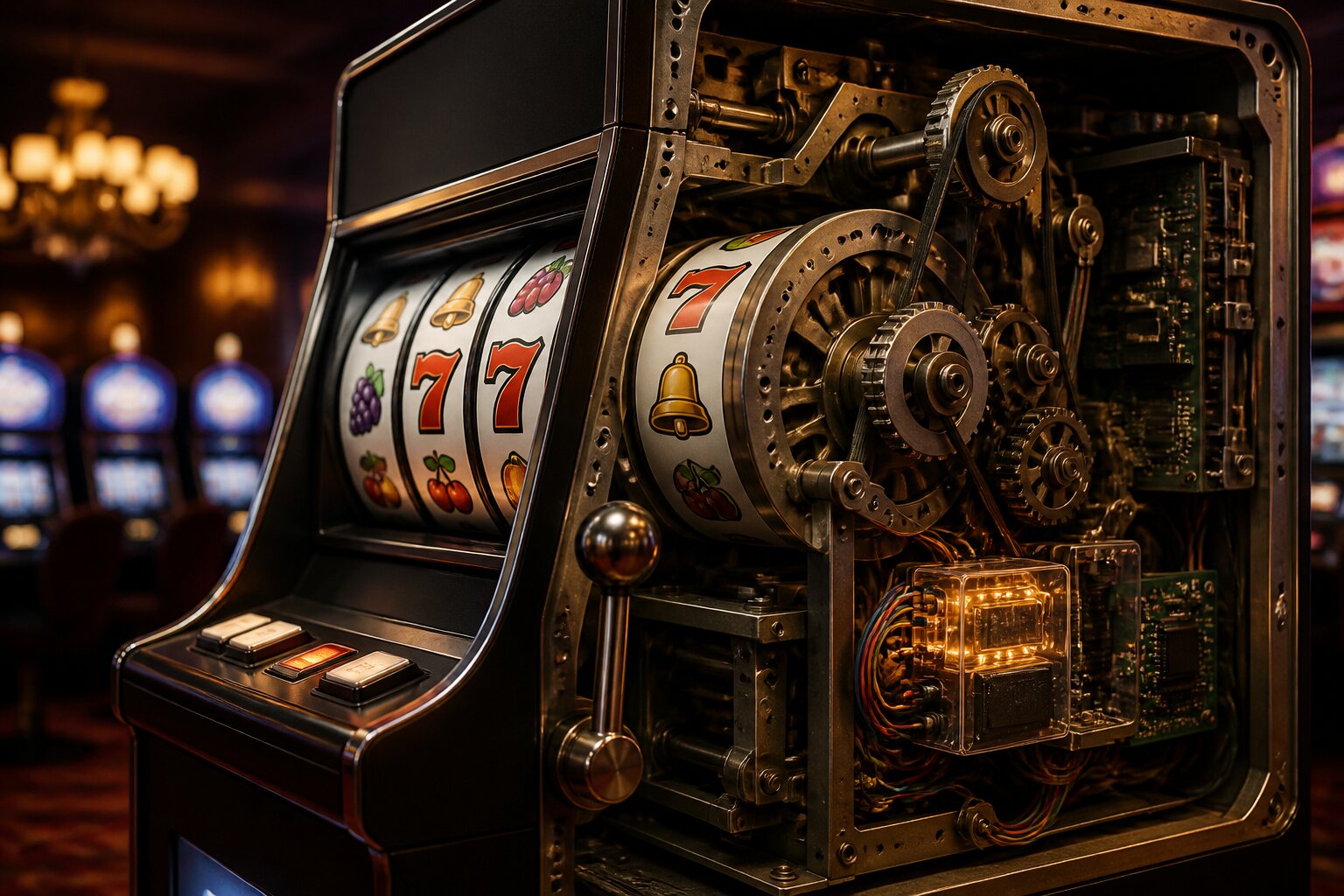
Early machines relied on physical parts: when a lever was pulled, springs and gears spun metal reels, and mechanical stops determined where they halted. The unpredictability in those machines came from the mechanics and the specific placement of stops on each reel. Maintenance and physical wear influenced performance, and the range of symbols and paylines was limited by the hardware.
Because each reel was a tangible object, operators could inspect and repair individual components. That made the machines easier to understand at a surface level, but it also meant that physical constraints limited creativity. Manufacturers could only add so many symbols, and the number of possible combinations remained relatively small compared with modern electronic systems.
Digital Animation and Video Slots
Modern video slots are software-driven. Reels are simulated on a screen and outcomes are derived from the RNG. This digital approach allows developers to introduce many more symbols, multiple paylines, complex bonus features and layered animations that would be impossible with physical reels.
The software environment also enables faster production of new titles and easier updates, since changes can be made to the code and imagery rather than rebuilt in metal and glass. From a player perspective, that creates a much wider variety of themes and mechanics, while the underlying mathematics still controls how often wins occur.
Although the presentation changed, the core notion remained: a predefined set of probabilities maps to outcomes. For readers curious about how those symbol arrangements translate into wins, the following section explains the relationship between symbols, paylines and payouts.
How Are Slot Outcomes Determined?
Outcomes are the result of how the RNG maps to symbol positions and how those symbols align on the game’s active paylines. The mapping defines the probability of each symbol appearing on each virtual reel, and those probabilities determine the frequency of specific winning combinations.
The Role of Symbols and Paylines
Symbols are the images that appear on reels; paylines are the lines or patterns across which matching symbols form a win. Modern games might use straightforward horizontal lines or more intricate patterns that cross the reels in several directions. The paytable, shown within the game, lists the winning combinations and the prize for each configuration.
How Payouts Are Calculated
When matching symbols land on an active payline, the payout is calculated from the paytable and the stake size. Higher-value symbols and longer matching runs typically deliver larger payouts. Bonus features such as free spins, multipliers or pick-and-reveal games adjust these calculations according to the same internal rules defined by the developer.
All of this is governed by programmed probability: the underlying code determines how often symbols appear and how often particular features trigger. Understanding this makes it easier to read a paytable and compare games based on the kinds of outcomes they tend to generate. With outcomes explained, the next question is whether those outcomes are genuinely random.
Are Slot Machines Truly Random?
Slots are built to produce outcomes consistent with the statistical model embedded in the game. The RNG is designed and tested to deliver numbers that, for practical purposes, are unpredictable and without bias, so the chance of any particular result conforms to the game’s defined probabilities.
Ensuring Fairness and Regulation
Regulatory frameworks require games to be independently tested and certified. Testing bodies assess RNG behaviour, verify that the mapping from RNG outputs to reel symbols is correct, and confirm that the stated return rates and feature frequencies are achievable within the game’s design. Operators must also make key game information available to players, such as paytables and percentage returns, to support transparency.
Common Myths About Slot Randomness
Some common beliefs — for example, that a machine is “due” to pay after a run of losses, or that patterns can be tracked to predict an upcoming win — are not supported by how RNG-driven systems operate. Because each spin is produced from a new RNG value, past outcomes do not alter the probabilities of future spins. Likewise, staff and operators cannot influence digital outcomes from the floor. If you’re curious about what factors do matter, RTP and volatility are the main design choices that affect how often wins occur and how large they tend to be; the next section explores that in detail.
Why Do Slots Have Different Return to Player (RTP) Rates?
Return to Player (RTP) expresses the long-term average percentage a game is designed to return to players from the total stakes placed. Developers set RTP based on the game’s structure, balancing factors such as how many bonus features exist, jackpot sizes and the intended frequency and scale of wins.
A higher RTP usually means smaller, more frequent wins on average, while a lower RTP often corresponds to the potential for larger but less frequent payouts. RTP is calculated over a very large number of plays — far beyond what any single session will represent — so a short gaming session can deviate widely from the long-term average.
RTP figures exist as a comparative tool so players can choose games that match their preferences for risk and reward. With an understanding of RTP, symbol mapping and randomness, players can better grasp what to expect from different slot designs and decide which ones suit their style.
Conclusion: What Does This Mean for Players?
Knowing how slot machines work brings clarity to what happens with every spin: software maps probability to outcomes, independent testing checks fairness, and paytables explain how wins are assembled. These elements combine so players can see how a game functions before they play.
This knowledge helps set realistic expectations about variability and return, and it supports sensible choices about which games to try. Overall, the best approach is to treat slots as entertainment with clearly defined rules and transparent numbers guiding how they behave.