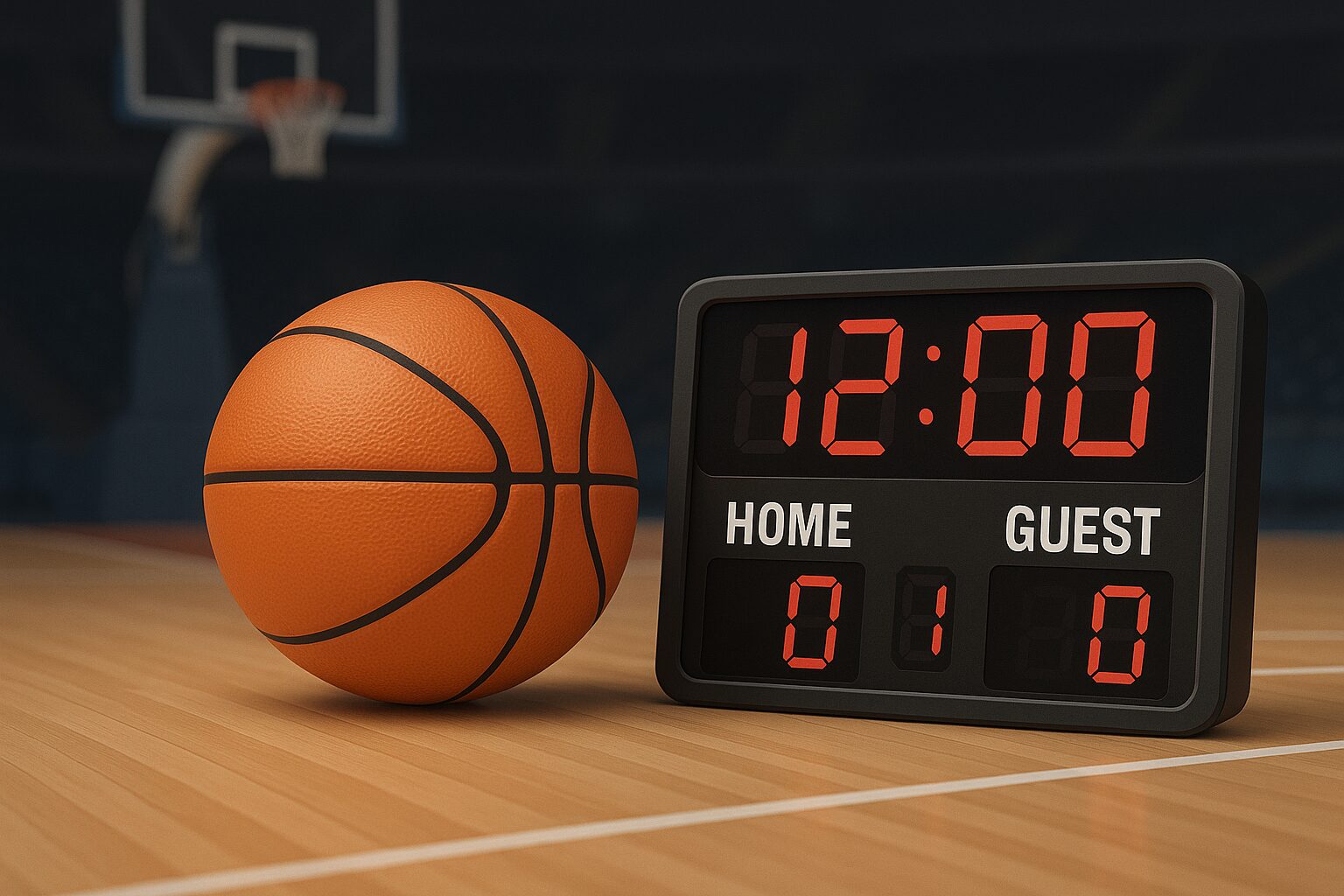
If you have ever settled down to watch a basketball match, or just glanced at the scoreboard, you might have wondered how long these games actually last. The timing is more involved than a simple countdown, with stoppages for fouls and a game split into quarters.
Once you know how the clock works, every run, timeout and review makes more sense. It also helps you follow the rhythm of the match from tip-off to the final buzzer.
This guide explains game length and quarter structure across the NBA, FIBA and UK leagues, plus youth levels and overtime, so you can watch any match with confidence.
How Many Quarters Are in a Standard Basketball Game?
A standard basketball match is divided into four quarters. This structure breaks the contest into clear phases that coaches and players can manage, and that viewers can follow. Short intervals between quarters, and a longer half-time, allow for tactical adjustments and recovery without disrupting the flow.
Most professional leagues, including the NBA, use four quarters. The exact length of those quarters depends on the competition, which is why timings vary between leagues. The NBA plays 12-minute quarters, while FIBA rules, used for international play and by most UK domestic leagues, set quarters at 10 minutes.
College basketball and some amateur formats use two halves instead of four quarters. In the United States, NCAA men’s games are two 20-minute halves, whereas NCAA women’s games use four 10-minute quarters. If you are switching between competitions, check the format and the period length in advance, and note that ties at the end of regulation are settled with additional overtime periods.
What Is the Length of Each Quarter?
Quarter duration depends on the league or competition, with rules set by the relevant governing body. The game clock measures active play only, so stoppages for fouls, time-outs and reviews mean the real-world length of a match is longer than the stated quarter times.
In the NBA, each quarter lasts 12 minutes, which contributes to a longer overall game compared with international play. If scores are level after four quarters, overtime periods of 5 minutes are used until a winner is decided.
For international matches governed by FIBA, including the Olympics and many domestic leagues worldwide, each quarter runs for 10 minutes. UK competitions such as the British Basketball League also follow this 10-minute format, as do the top European competitions. The WNBA likewise uses 10-minute quarters.
College basketball in the United States typically uses two 20-minute halves for the men’s game. The women’s college game is played in four 10-minute quarters, bringing it closer to the international structure. Other levels, such as youth, schools or local leagues, can set their own timings to suit player age and scheduling, often using shorter quarters or halves.
Whatever the league, there is a short interval between the first and second quarters and between the third and fourth, with a longer half-time break in the middle. Quarter breaks are usually around two to three minutes, while half-time is commonly about 15 minutes, although exact timings can vary by competition and broadcast requirements.
Some competitions also include official time-outs at set points within each quarter, which pause the clock and allow teams to make adjustments. If a match is tied at the end of regulation time, an overtime period, usually 5 minutes, is added and repeated as needed. Those pauses help teams reset and prepare for the next phase of play.
Differences in Game Duration: NBA vs. FIBA vs. UK Leagues
Total game time varies by league because of different quarter lengths and how stoppages are handled. Overtime and broadcast requirements can add a little extra on top.
The NBA schedules four 12-minute quarters. With timeouts, reviews, free throws and intervals, a full NBA game usually runs about two to two and a half hours from start to finish. Overtime periods last five minutes, which extends the window further.
FIBA competitions play four 10-minute quarters. Factoring in stoppages and breaks, these games generally take around one and a half to two hours. UK leagues that follow FIBA timing fall into the same range. Timeouts are fewer than in the NBA and video reviews are less frequent, so the action tends to flow more consistently.
If you alternate between NBA broadcasts and international fixtures, expect the pace and overall viewing time to feel a little different.
How Long Are Basketball Games at School and Youth Levels?
School and youth games in the UK are usually shorter to suit player development and age-group needs. Shorter quarters help manage fatigue and ensure plenty of court time for developing players, with rolling substitutions often encouraged.
Many use four quarters of around six to eight minutes each, though exact timings vary by age and competition rules. At mini-basket and primary levels this is common, while older age groups may play eight to ten minute quarters. Some formats use a running clock that stops less often, which brings matches to a close more quickly. Finals or higher tiers are more likely to use stop-clock rules, pausing for fouls and violations.
Allow roughly 45 minutes to an hour for a typical youth game, including short breaks between quarters and half-time. This covers brief stoppages, time-outs and intervals. If overtime is required, expect a short extra period that can extend the total slightly, though some leagues allow draws to keep schedules on time.
What Happens in Overtime Periods?
Overtime is used when the scores are level at the end of regular time.
In most professional leagues, including the NBA, FIBA and UK competitions, an overtime period is five minutes. If scores remain level, additional five-minute periods are played until there is a winner. Teams get a brief break before each new period begins, and standard rules continue to apply.
Overtime usually begins with a jump ball, and while personal fouls carry over, team fouls and time-outs reset in line with each competition’s rules.
Factors That Affect the Total Length of a Basketball Game
While quarter lengths set the framework, the real-world duration depends on how often the clock stops and how the game unfolds.
Below you will find some of the most common reasons basketball matches may be extended.
Typical Stoppages and Timeouts Explained
Fouls and free throws: When a foul is called, the game pauses. That can include time for referees to confer or review and for shooters to take their free throws.
Timeouts: Each team has a set number of timeouts, with the number and length varying by league. Coaches use them to adjust tactics or manage player fatigue, which adds minutes across a game.
Injuries: Play stops while injured players receive attention and substitutions are arranged, which naturally extends the running time.
Instant replay reviews: Professional leagues may stop to review close calls, such as buzzer-beaters or out-of-bounds decisions. Reviews support accurate officiating but can add a little time.
Other routine pauses include the ball going out of bounds, substitutions and resets after violations, all of which contribute to the total duration.
Do All Basketball Games Last the Same Time?
No. The final duration depends on the league format, how many stoppages occur and whether overtime is required. NBA games typically last longer than FIBA or UK fixtures because of 12-minute quarters, while youth games are shorter by design. Most UK competitions follow FIBA rules with four 10-minute quarters, US college games use two 20-minute halves, and some junior leagues run a running clock.
If a match features many fouls, reviews or timeouts, expect it to run longer than one with continuous end-to-end play. Breaks for half-time, quarter intervals, injuries and media timeouts add up, and overtime is usually five minutes per period.
Summary of Key Points on Basketball Game Length
- Professional games are usually four quarters. NBA quarters are 12 minutes, while FIBA and UK leagues use 10 minutes.
- College games in the United States often use two 20-minute halves. Youth formats vary, with shorter quarters and sometimes a running clock.
- Overtime periods are five minutes and repeat until there is a winner.
- Stoppages for fouls, timeouts, injuries, reviews and routine restarts mean the real viewing time is longer than the raw quarter totals.
If you choose to bet on basketball, set limits and only stake what you can afford. For league-by-league timings and viewing options, explore our guides.