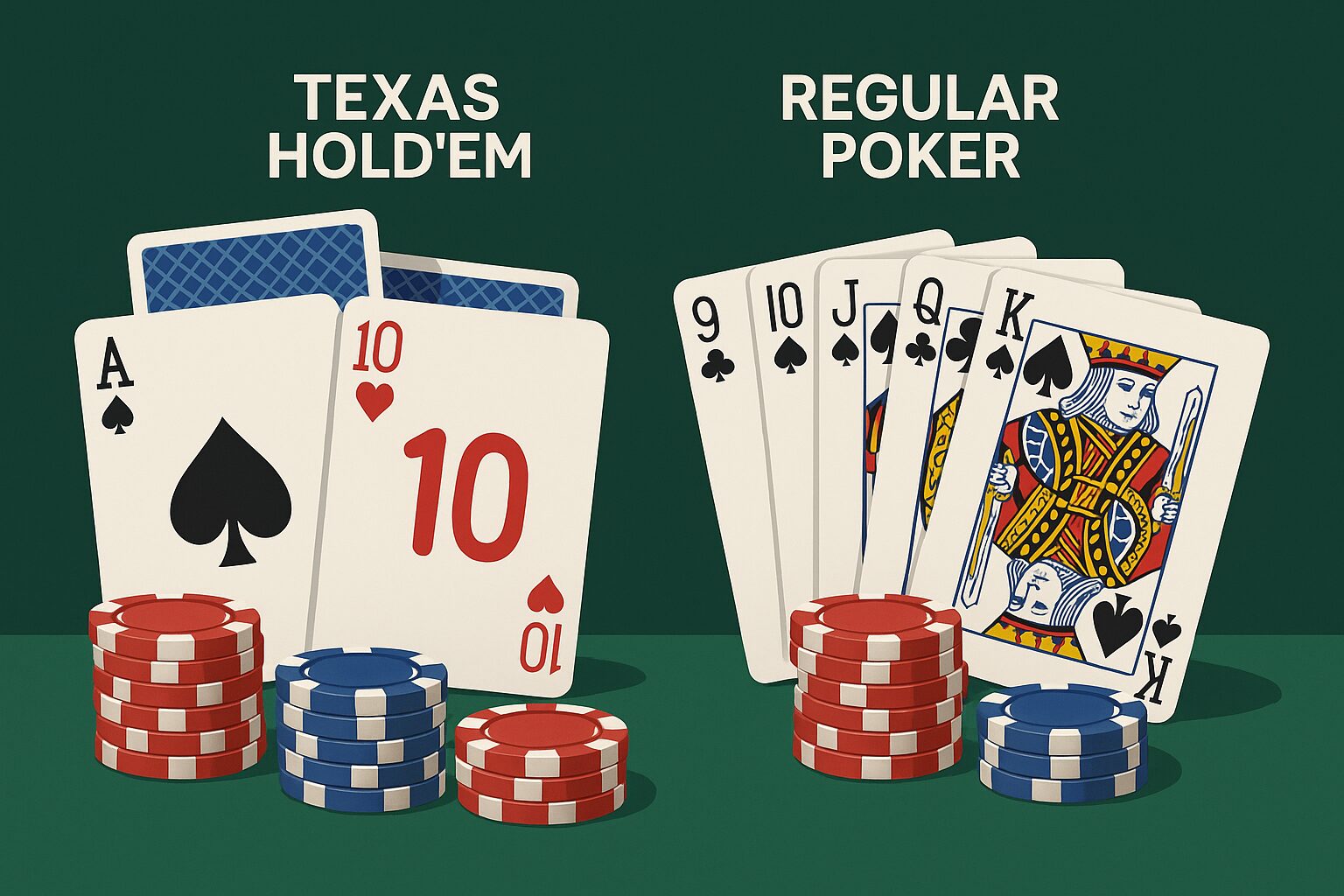
If you are curious about what sets Texas Hold’em apart from what many call regular poker, you are not alone. These games may look similar at first glance, but there are some important differences worth knowing before you take a seat at the table.
Understanding the unique features of each can make your poker nights smoother, whether you are a complete beginner or brushing up on the basics.
Read on to explore the rules, gameplay, and strategies that separate Texas Hold’em from traditional variants. If you would like side by side breakdowns, our in house guides and comparisons are a handy next step.
What Is Regular Poker?
When people mention regular poker, they are usually talking about classic versions of the game that were popular before Texas Hold’em took centre stage. The most common examples are Five Card Draw and Seven Card Stud, both long-standing favourites in home games and some card rooms.
In these traditional formats, each player receives their own set of cards, with limited or no shared cards on the table. That changes the flow of information, as you work mainly with your private cards and, in stud, any exposed cards your opponents show along the way.
In Five Card Draw, everyone is dealt five private cards, then has one opportunity to swap some of them for new ones to improve their hand. Typically there is an initial betting round, the draw where players can replace between zero and five cards, then a final betting round before any showdown.
Seven Card Stud works differently. Players receive a mix of face up and face down cards across several betting rounds, then make the best five card hand from the seven they have seen. It usually starts with two cards face down and one face up, followed by more face up cards and a final face down card. Instead of blinds, antes and a bring-in bet are common.
Each variation has its own rules for dealing, betting, and winning hands, but they all share the same goal of making the strongest possible five card combination. Hand rankings are consistent with most poker games, and tables may use fixed or spread limit betting. If you choose to play for real money, understand the rules, set sensible limits, and keep control of how much time and money you spend. Outcomes are never guaranteed.
How Does Texas Hold’em Differ from Regular Poker?
Texas Hold’em stands out because of how cards are dealt and used. Instead of getting a full set of private cards, each player receives two hole cards that only they can see.
Five community cards are then placed face up in the middle of the table. Every player can use these, together with their two hole cards, to make the best five card hand.
Betting is also structured differently. Hold’em has several betting rounds, starting before any community cards are revealed, then again after the flop, the turn, and the river. Most games use blinds rather than antes, which encourages action before the cards are even seen. This rhythm creates frequent decision points that reward careful planning and observation.
While classic games like Five Card Draw or Seven Card Stud have their own appeal, Hold’em’s shared cards and layered betting give it a distinct feel that many players enjoy.

Discover The Best Online Casinos
Browse our list of top-recommended casino sites, read reviews from real players & be the first to get access to the latest casino bonuses
Game Structure: Comparing Betting Rounds and Community Cards
In regular poker games such as Five Card Draw and Seven Card Stud, the flow contrasts noticeably with Texas Hold’em.
Five Card Draw usually has two betting rounds. There is one before the draw and one after players choose which cards to replace. There are no community cards, so your decisions are based solely on your private hand and what you infer from opponents’ actions.
Seven Card Stud features up to five betting rounds as players receive cards one at a time, some face up and some face down. Again, no cards are shared. You make decisions using your private cards and the upcards you can see on other players’ hands.
Texas Hold’em introduces four betting rounds linked to the community board. There is an initial round with only the hole cards, then three more that follow the flop, turn, and river. Because all players see the same board, hand possibilities are more transparent, which changes how you evaluate strength, draws, and potential bluffs.
Hand Rankings: Are They the Same in Both Games?
Yes. Most forms of poker, including Texas Hold’em and regular variants like Five Card Draw and Seven Card Stud, use the same hand rankings. Across these games, hands are compared as five-card combinations, whether those cards come from your own hand, the board, or a mix of both.
The strongest hand is a royal flush, which is simply the highest possible straight flush, and the weakest is a high card with no combinations. In between are pairs, two pair, three of a kind, straight, flush, full house, and four of a kind. Aces can be high or low in a straight, so A‑2‑3‑4‑5 is valid, but you cannot go wraparound (Q‑K‑A‑2‑3). In most formats, suits do not have a rank, so truly identical hands result in a split pot.
When players share the same category of hand, kickers decide the winner. For example, top pair with a stronger side card beats the same pair with a weaker one. In Hold’em you always make your best five-card hand from seven available cards; in Draw and Stud you still compare five-card results.
Some niche formats tweak the order or add special rules, such as lowball or hi‑lo split, but that is not typical for Hold’em, Draw, or Stud. Always check the table rules before you play.
Player Interaction and Table Dynamics
Table dynamics feel different from one variant to another. In Draw and Stud, you focus on your own cards and, in Stud, the visible upcards on the table. Reading patterns often centres on betting behaviour, replacement choices in Draw, and the story that face up cards tell in Stud. Tempo, the willingness to stand pat, and how players respond to the bring-in or completion can all offer hints, though none of these cues are reliable on their own.
Hold’em encourages more shared analysis because everyone works from the same community board. Players weigh how the flop, turn, and river interact with ranges, which naturally invites more table chat and collective attention on each new card. Pre-flop action, stack depth, and whether a pot is heads up or multiway shape how freely people discuss likely holdings, with etiquette usually keeping any hand-specific advice until after the pot is finished.
Both styles reward patience, clear thinking, and good awareness of position at the table. Early seats tend to play tighter, late position can apply pressure, and that basic rhythm carries across variants. Short handed tables, antes, and changing stack sizes add further layers, so staying adaptable and observing how others react to these shifts helps your decision making.
Keep chat friendly and within house rules. Do not reveal folded cards or live hand details, avoid influencing a hand in progress, and respect table pace. Fair play supports a better experience for everyone.
Why Is Texas Hold’em So Popular?
Texas Hold’em is widely recognised because it is straightforward to learn yet offers depth for those who want to develop their skills over time. Two hole cards and a shared board keep the action easy to follow, even for newcomers. As you progress, position and bet sizing introduce learnable layers.
Televised tournaments and film appearances have also played a part, showcasing how strategy unfolds across the flop, turn, and river. Live streams now break down ranges and betting patterns in real time.
That visibility has made it simple to find games, study materials, and communities to learn with online and in person.
Another draw is flexibility. Hold’em works well in friendly games, clubs, and regulated online rooms, so you can find a table at almost any level. Licensed sites provide deposit limits and time-outs to help you stay in control.
Common Myths: Is Texas Hold’em Harder than Regular Poker?
A frequent myth is that Texas Hold’em is much harder than other forms of poker. What many people mean by regular poker varies, whether that is Five-Card Draw, Seven-Card Stud, or a fixed-limit game, and each calls on slightly different skills. In truth, difficulty depends on what you find intuitive. Some players click quickly with community cards, while others prefer the directness of Draw or the open information in Stud. Hold’em asks you to weigh how shared community cards interact with a wide range of starting hands, Draw leans more on reading betting patterns with limited visible information, and Stud rewards memory of exposed cards and tracking what has already folded. Perceived difficulty also shifts with table size, betting structure, and the standard of the players you face.
The basics of each variant can be learned with a short rules recap and a few practice sessions. Once you can follow the betting rounds and hand rankings comfortably, you will progress faster by focusing on core ideas such as position, starting hand selection, and bet sizing. From there, improvement comes from experience, note taking, and reviewing key decisions rather than from chasing shortcuts or making risky leaps. Keep sessions focused and manageable, pause to record tricky spots, and revisit them when you are fresh.
If you are unsure where to start, pick one format, learn the rules, and play at a comfortable pace. Many people find it helpful to begin with smaller tables or shorter sessions so decisions stay clear and measured. You can always branch out once the fundamentals feel natural. Whether you try cash games or small tournaments, aim to play within a set budget, take regular breaks, and make use of safer gambling tools where available.
Which Variant Is Best for Beginners?
Both Texas Hold’em and regular poker variants can suit beginners, depending on learning style.
Hold’em is often the first stop thanks to clear rules and the visibility of the community board. Many players find it easier to follow how a hand develops when everyone can see the same five shared cards. By contrast, Five Card Draw keeps the focus entirely on your private hand and a single draw decision, which some newcomers find simpler.
Stud offers helpful clues through visible upcards, though the extra betting rounds can feel busier at first. If you prefer a calm pace, Draw may appeal. If you enjoy step by step board development and plentiful learning resources, Hold’em is a strong option.
Whichever you choose, start small, take your time between decisions, and review a few hands after each session to spot what worked and what did not. Our guides and comparisons can help you select a format that fits your goals.
Summary of Key Differences and Considerations
Texas Hold’em and regular variants differ mainly in how cards are dealt, the use of community cards, and the number and timing of betting rounds. Hold’em relies on two private cards plus a shared board with four betting streets, while Draw and Stud keep cards private, use no shared board, and follow their own distinct dealing patterns.
Hand rankings are largely the same across these games, which makes switching between formats straightforward. Table feel varies, too. Hold’em often creates more collective focus on the board, whereas Draw and Stud place more emphasis on private information and, in Stud, visible upcards.
When choosing a style, think about the pace you enjoy, how much open information you like, and where you plan to play. Set clear limits, use available tools, and keep sessions within your comfort zone.
For deeper comparisons, visit our guides and side by side resources. Once you understand how these formats differ, picking the right game becomes simple, and you can sit down with confidence.