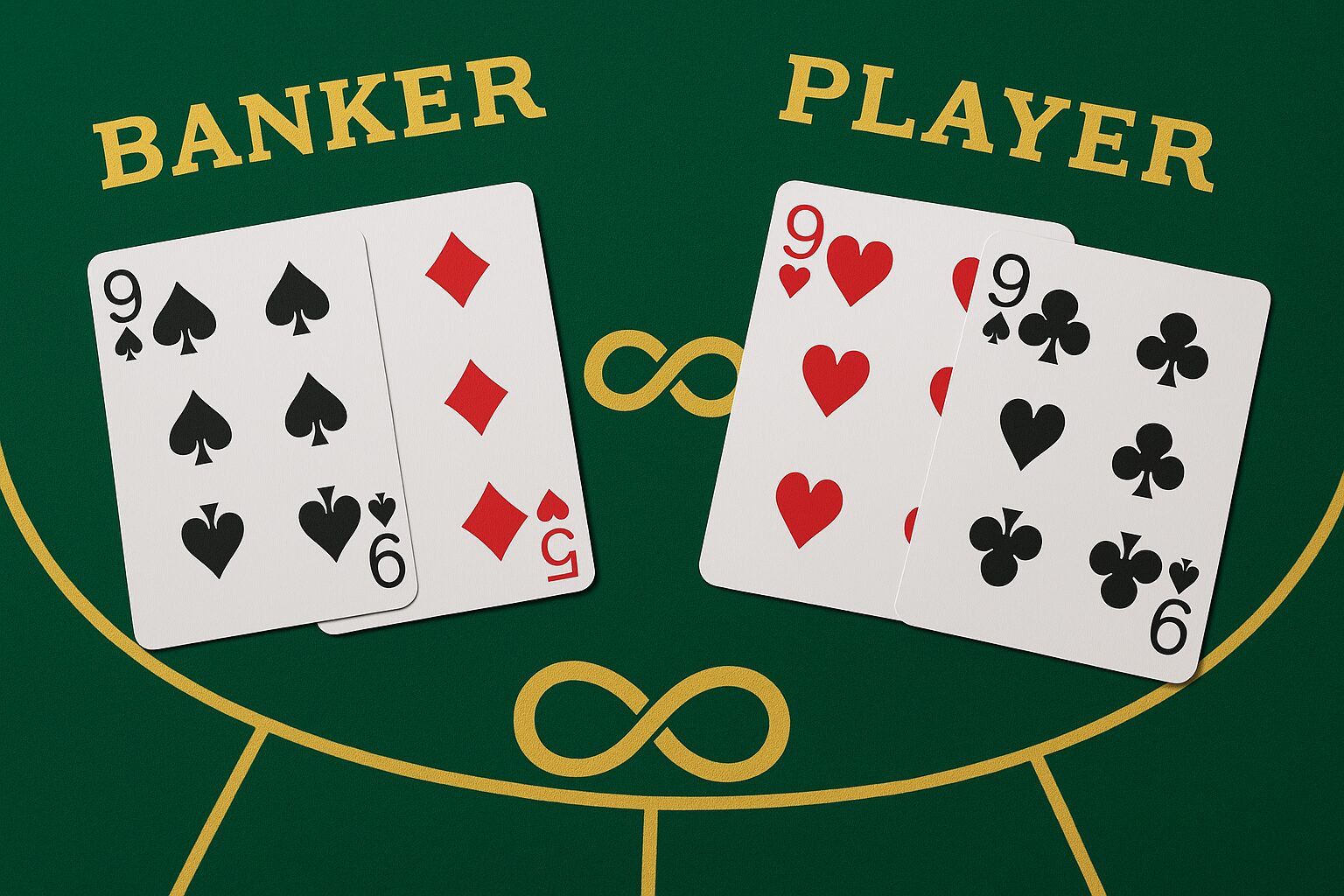
Baccarat is a straightforward card game, but when both the Player and Banker hands finish with the same value, things get a little more interesting. Many new players wonder exactly what a tie means for their bet, and what rules come into play when this outcome occurs.
Understanding tie rules matters because they determine how bets are settled and how payouts are calculated. Knowing this upfront helps you read the table clearly and make informed choices.
This guide explains what a tie is, how it’s decided, what it pays, and what it means for your other bets. It follows general industry rules and is not specific to any operator.
What Is a Tie in Baccarat?
A tie in baccarat happens when both the Player and Banker hands have the same total at the end of a round. Totals run from 0 to 9; tens and picture cards count as 0, aces as 1, and only the last digit of any total of 10 or more is used. When the two totals match, neither side wins or loses.
You might also hear it called a draw or standoff, but tie is the standard term. It applies only after all cards for that round have been dealt. For example, if both hands finish on 6 or both show 8, the result is a tie.
In most games, a tie means Player and Banker wagers are pushed and the stake is returned. Only a separate tie wager, if placed, is settled according to the table rules. Check the house rules, as procedures can vary.
This is one of three possible outcomes in a round, alongside a Player win or a Banker win.
How Are Ties Determined in Baccarat?
Ties are decided by comparing the final totals for the Player and Banker hands after all drawing rules are applied. Each hand starts with two cards and may receive a third, following fixed table rules. If a natural 8 or 9 appears, drawing stops immediately before the totals are compared.
- Cards 2 through 9 are worth their face value.
- 10s and picture cards count as zero.
- Aces are worth one point.
- Only the last digit of the sum counts. So 14 becomes 4, 17 becomes 7, and so on. Totals therefore sit between 0 and 9.
Suits do not matter, and jokers are not used.
If both hands finish on the same total, the round is a tie. There is no extra play or tiebreaker. This result simply stands. On most tables, Player and Banker wagers are treated as a push in this case, so the stake is returned. A separate Tie wager, if offered and placed, pays out only when the hands tie. Payouts and rules vary by casino or game provider, so check the table information before you play.
As a quick example: if the Player’s cards total 7 + 8 = 15, that counts as 5. If the Banker’s cards total 9 + 6 = 15, that also counts as 5. The hand is a tie.
Another example with three cards: Player draws 3 + 4 + 3 = 10, which counts as 0. Banker shows 2 + 8 = 10, also 0. That is also a tie.

Discover The Best Online Casinos
Browse our list of top-recommended casino sites, read reviews from real players & be the first to get access to the latest casino bonuses
What Are the Payouts for a Tie Bet?
A tie bet in baccarat usually pays 8 to 1. So if you bet £1 and the result is a tie, you would typically receive £8 in winnings plus your original £1 back. For a slightly larger example, a £5 tie bet at 8 to 1 would pay £40 in winnings, with £45 returned in total including your stake.
Remember that a tie outcome usually means Banker and Player bets push, so they are returned without any profit or loss. Only a specific tie bet pays when the result is level.
Some games pay 9 to 1 on ties, although this is less common and depends on the specific table rules. Always check the paytable or rules before you play so you know exactly what applies. On most online tables you can see this on the felt or in the information panel. At 9 to 1 a £2 tie bet would pay £18 in winnings, with £20 returned in total.
Table limits for tie bets can differ from the limits on Banker or Player, and the number of decks or specific drawing rules may vary by game. These factors can influence the underlying maths, so it is sensible to confirm both the payout and any limits in advance.
For context, the house edge on a tie bet is roughly 14.36% with an 8 to 1 payout, and about 4.85% if the table pays 9 to 1. Ties occur relatively infrequently, roughly around one in ten hands on standard multi-deck games, which means results can be volatile.
Even with a 9 to 1 payout, the tie bet’s house edge is still much higher than the Banker or Player bets, which are typically around 1.06% and 1.24% respectively. Keep your staking proportionate to your budget, and avoid chasing losses.
Are Tie Bets Common in Baccarat?
Tie results are relatively uncommon compared to Player or Banker wins. Using standard eight-deck rules, a tie appears in just under 10% of rounds, typically around 9.5%, though it can vary slightly with deck number and house rules.
This rarity is why tie bets pay more than Player or Banker bets. That said, those figures are long-term averages. In short sessions you may see more or fewer ties than the expected rate.
If a tie occurs, Player and Banker wagers usually push, so your stake is returned.
How Does a Tie Affect Other Bets?
When a round ends in a tie, bets on Player or Banker are treated as a push. Your original stake is returned and you neither win nor lose on that hand. No commission applies because there is no winning outcome on those bets.
On the main outcome, only those who placed a tie bet receive a payout when a tie occurs. Everyone else has their stake returned and can decide what to do next. Any optional side bets, if available, are settled under their own rules and may still result in a win or a loss.
For example, if you bet £10 on Banker and the hand ties, you will have your £10 returned and can choose your next wager. Some tables leave chips in place by default, but you can change or remove them before the next deal.
Is the Tie Bet Worth It?
From a statistical point of view, the tie bet is generally less favourable than Player or Banker. The house edge on a tie is much higher, at around 14.36% when it pays 8 to 1. By comparison, the house edge is roughly 1.06% on Banker and about 1.24% on Player, based on standard eight-deck rules. If you find a game that pays 9 to 1 on ties, the tie edge drops to around 4.85%.
Those numbers do not make the tie bet “wrong,” but they do explain why many players focus on Player or Banker if they care about expected outcomes over time. Whichever way you choose to play, set sensible limits and avoid chasing results.
Common Myths About Tie Bets
Before you decide whether to include tie bets in your play, it helps to clear up a few common misconceptions.
Myth 1: Tie bets are due to hit after a losing streak.
There is no pattern to when ties occur. Each round is independent, so the chance of a tie is the same from one deal to the next.
Myth 2: Higher payouts mean ties are better bets.
A bigger payout does not automatically make it a stronger bet. The odds of a tie are lower, and the house edge is higher than on Player or Banker in most games.
Myth 3: Some systems can guarantee a win on ties.
No system can remove the house edge or predict a specific result. Outcomes are determined by the rules and the cards drawn.
How Should You Respond to a Tie Outcome?
If you placed a tie bet and the round ends in a tie, you’ll be paid according to the table’s payout, often 8:1 or 9:1. If you bet on Player or Banker, your stake is returned as a push. Check the paytable and house rules at your table.
There is no need to change your approach just because a tie appeared. Each round is separate and previous results do not affect the next hand. You can repeat your last bet, switch to a different option, reduce your stake, or pause and review your spending. Avoid chasing losses.
What Does the Tie Outcome Mean for Dealers and Players?
When a tie occurs, the dealer announces the result and settles the table accordingly. Tie bets are paid out, and Player and Banker stakes are returned to those who placed them. This counts as a push on the main hands, and any side bets are settled separately in line with the displayed paytable.
After that, the dealer collects the cards and prepares for the next hand. Players can then decide whether to place a fresh bet, adjust their stakes, or sit out a round.
Baccarat should only be played with licensed operators and is strictly for adults. If you are unsure about house rules at a table, ask the dealer or check the on-screen help section before you wager. Set sensible limits and never chase losses; support is available at BeGambleAware.org.
Can a Game Continue After a Tie in Baccarat?
Yes, play carries on as normal. Once payouts are made and stakes are returned, the cards are collected and the next hand begins with no change to the rules.
You can place your next bet on Player, Banker, Tie, or any available side option, depending on the table. If you would like to compare trusted places to play and see which baccarat rules or payouts you prefer, browse our latest lists and comparisons.