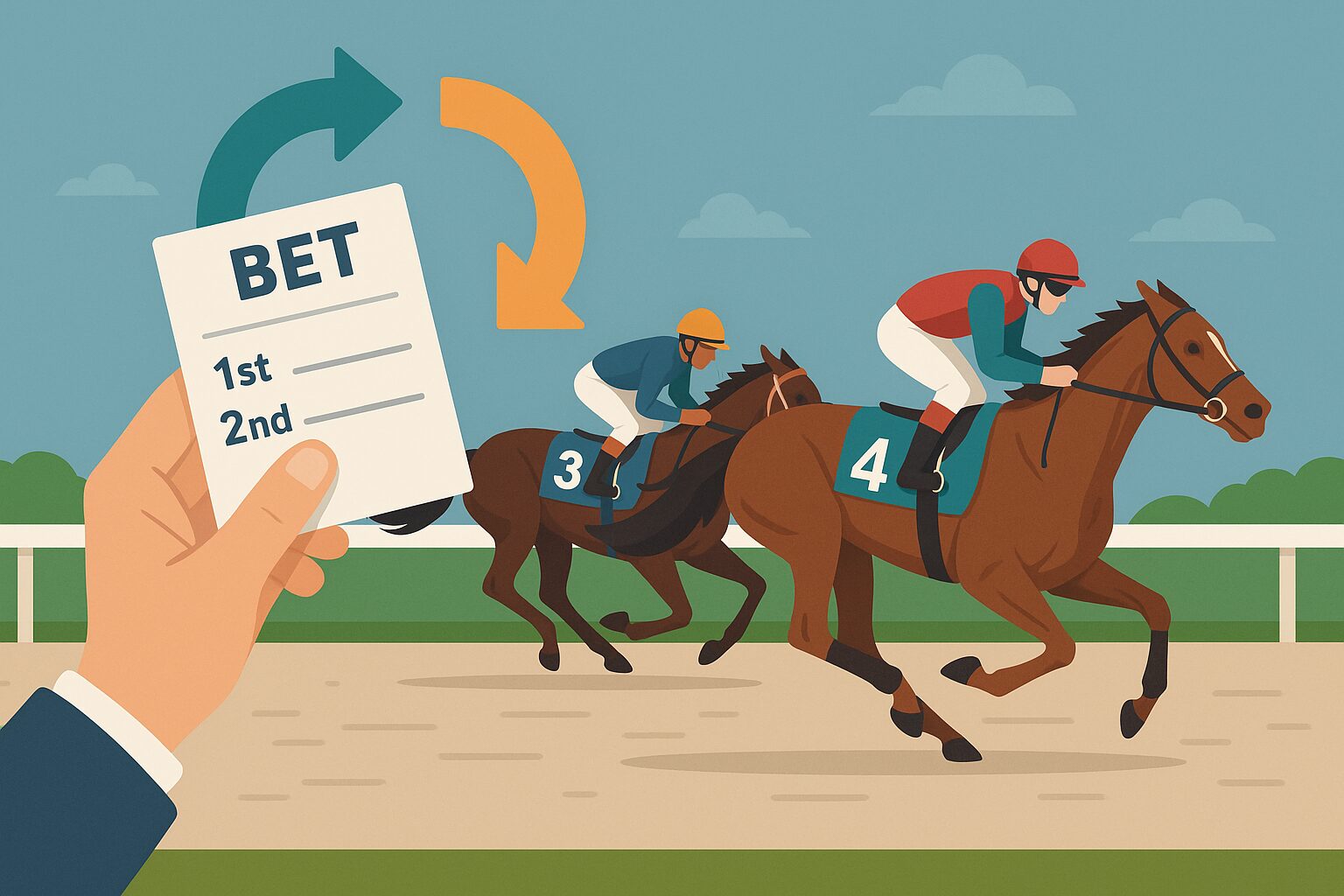
Looking to try something different to a standard win bet? A reverse forecast could be just the thing.
It is a popular choice in UK horse racing because it lets you back two runners to fill the top two places without having to pin down the exact order. In this guide, you will find a clear explanation of how it works, how it compares with a straight forecast, and the key rules to know before you stake.
Before placing any bets, check our lists and comparisons to find trusted, UK‑licensed betting sites, and always set a budget you can afford.
What Is a Reverse Forecast Bet in Horse Racing?
A reverse forecast is a bet where you pick two horses to finish first and second in any order. Both must place in the top two for the bet to succeed, but the sequence does not matter. You are effectively covering both possible 1–2 combinations with the same pair of runners.
It differs from a straight forecast, where you must name the exact 1–2. With a reverse forecast you are effectively placing two separate bets, one for each possible order, so the total stake is doubled. For example, a £5 reverse forecast costs £10 in total. Settlement is usually based on the bookmaker’s Computer Straight Forecast for the winning order, so returns are not fixed and can vary by race.
Many punters use this when they rate two horses highly but do not want to commit to a specific finishing order. If there is a dead heat or a non-runner, firms apply their forecast rules, which may reduce or void parts of the bet, so always check terms before staking and keep control of your spend.
How Does a Reverse Forecast Differ From a Straight Forecast?
The difference lies in the finishing order you need to get right. Both involve picking the first two home, but how precise you need to be, and how the stake is used, is not the same.
Straight forecast: name the first and second in the correct order. If you swap the order, the bet loses. For example, a £2 straight forecast on Horse A to beat Horse B only pays if A finishes first and B second.
Reverse forecast: name two horses to finish first and second in either order. Because you are covering both sequences, the stake is doubled (a £1 reverse forecast costs £2 in total). Only the correct order that occurs is settled as a winner, so one line wins and the other loses.
Returns are settled to the operator’s forecast formula or Tote dividend for the exact 1-2 that happens. If there is a non-runner, firms usually void the affected part or may convert the bet according to their rules. Forecasts typically require at least three runners to start, otherwise the bet is usually void.
Choosing between them comes down to how strongly you feel about the exact pecking order versus paying a little more for flexibility. If you have a firm view on who beats whom, a straight forecast keeps the stake down. If you think two stand out but are unsure of the 1-2, a reverse forecast covers both possibilities at twice the unit stake.
Which Races Allow Reverse Forecast Betting?
Reverse forecasts are generally available on UK horse races with three or more runners, across both Flat and National Hunt cards. In practice they appear on most races where at least three go to post. They will not be offered in very small fields, and availability can change if the line-up shrinks due to non-runners.
Bookmakers set their own house rules on which races qualify and how they handle changes to the field, so it is worth checking the race page or the operator’s rules section before you place your bet. Forecasts are seldom offered ante post or in-play, and pool products like the Exacta follow separate rules.
How to Place a Reverse Forecast Bet Online and in Betting Shops
Placing a reverse forecast is straightforward once you know where to look on the bet slip.
Online
- Go to the horse racing section and select your race.
- Add your two chosen horses to the slip, then choose the reverse forecast option. The slip will show the combined stake for both orders.
- Confirm the details, including stake and race time, before you place the bet.
In Betting Shops
- On a paper slip, write the meeting, race time, your two selections, and mark reverse forecast. Staff can check it is filled in correctly if you are unsure.
- On a self‑service terminal, select the race, tap your two runners, and choose reverse forecast on the on‑screen slip.
Wherever you bet, take a moment to review your stake and set sensible limits. Avoid chasing losses.
What Happens If There Are Non-Runners or a Dead Heat?
If one of your selections is declared a non‑runner before the off, most operators will adjust the bet. With straight forecasts, the usual outcomes are either settling the remaining part as a straight forecast with your other horse to beat the field or refunding the affected part of the stake. For reverse or combination forecasts, any lines that include the non‑runner are normally voided and the rest of the bet stands. If the race cuts to only two runners, many firms do not produce a forecast return, so your bet may be settled as a single on the remaining selection or made void, depending on house rules.
Be aware that ante‑post bets are different. If your selection is a non‑runner under ante‑post terms, the stake is typically lost and no part of the bet is adjusted, unless the operator states otherwise. Always check whether your bet was placed under day‑of‑race or ante‑post rules.
Dead heats can affect settlement too. If your selection dead heats for first or second, payouts are usually divided in proportion to the number of horses sharing that place. For example, if two horses dead heat for second and one of them is your pick, settlement on that part of the forecast is typically halved. With a reverse forecast, each direction is settled separately using split stakes where a dead heat applies.
If you are ever in doubt, refer to the operator’s settlement rules or ask in‑shop staff for clarification before you bet. You can also request a settlement breakdown once the result is confirmed.
Potential Payouts: What Can You Win With a Reverse Forecast?
Returns on a reverse forecast are based on the starting prices of your two selections and the official forecast dividend used by the operator or racecourse. Because you are covering both finishing orders, you are placing two bets, so your total stake is doubled. Only the part that matches the actual finishing order pays; the other part loses even if your two picks fill the first two places.
Dividends vary between firms and races. Forecasts that involve short‑priced favourites often return less than forecasts built from bigger‑priced runners, and the exact amount depends on how the operator calculates the payout. Settlement may follow the industry computer forecast or a pool dividend. There are no fixed returns, so check the site’s rules and tools if you want an estimate before you stake.
Keep your expectations realistic and stake only what fits your budget. Non‑runner and dead‑heat rules can also affect settlement, and some operators may apply maximum payout limits.
Is a Reverse Forecast the Same as a Reverse Exacta?
Yes in principle, although the terminology differs by region. In the UK, bookmakers use reverse forecast to describe backing two horses to finish first and second in either order. In the United States and some other regions, the same idea is commonly called a reverse exacta. In practice, you are placing two bets on the same pair of runners to cover both finishing orders.
If you are betting on UK races with UK‑licensed operators, reverse forecast is the term you will usually see. It is typically treated as two straight forecasts, so your stake is doubled. For example, a £2 reverse forecast costs £4 in total and returns if your selections finish 1-2 or 2-1. With tote or pool-style bets, the equivalent in some countries is a two-horse exacta box, and the return is based on the declared dividend for the actual finishing order.
If you switch to international events, always check the wording on the bet slip so you know exactly what you are placing. Terms can vary by operator, especially around minimum field sizes, what happens with non-runners, and how dead-heats are settled. Some firms may void affected parts of the bet, while others apply their published forecast or exacta rules. Reading the specific rules before you confirm your stake helps you understand the cost and how any payout would be calculated.
Common Myths and Misunderstandings About Reverse Forecasts
A few misconceptions are worth clearing up:
A reverse forecast is not automatically easier to win than other bets. Both selections still need to finish in the top two. You are still covering two exact orders.
The payout is not simply double a straight forecast. Although a reverse forecast is two bets, returns depend on the prices of both horses and the forecast dividend. Only the correct order pays from the two stakes.
Reverse forecasts are not offered on every race. The field must meet the operator’s criteria, and availability can change if there are non‑runners. Minimum runner requirements apply, and terms can change after withdrawals.
Settlement rules are not identical across all bookmakers. There can be small differences in how non‑runners and dead heats are handled. Check the house rules before you stake.
Understanding these points helps you compare options and avoid surprises at settlement time. If in doubt, review the race terms first.
Pros and Cons of Using Reverse Forecast Bets
Like any bet type, reverse forecasts have strengths and trade‑offs. They are two straight forecasts in opposite orders, so they cover both possible one‑two finishes for your pair while still needing both to place.
Pros:
You get flexibility on finishing order, which can suit races where two runners stand out but are hard to split. This works best in small or mid‑sized fields where you expect the pair to finish ahead of the pack, or where pace and draw make the order uncertain.
Cons:
The stake is doubled, as you are placing two bets. Both selections still have to make the first two for any return, and forecast dividends can be lower when the top places are filled by short‑priced horses. Payouts can also vary by settlement method, and dead‑heats or non‑runners may change how bets are settled, so check the rules before staking.
Think about race conditions, prices and your staking plan before deciding whether a reverse forecast fits. Set limits and bet within your means, and consider tools such as deposit limits or time‑outs to help you stay in control.
Frequently Asked Questions About Reverse Forecast Bets
Can I include more than two horses in a reverse forecast?
No. A reverse forecast covers exactly two selections. If you want to cover more runners, consider a combination forecast.
Is a reverse forecast available on all horse races?
Not always. They are generally offered on races with three or more runners, but availability can vary and may change if there are withdrawals.
How do I calculate my potential winnings?
Returns depend on the prices of both horses and the forecast dividend used by the operator. Use the site’s tools or check the rules section for guidance on how they calculate payouts.
What happens if there is a non‑runner?
Most bookmakers adjust the bet according to their rules, often by settling the remaining part as a straight forecast or refunding the affected portion. Check the small print to be sure.
Can reverse forecast bets be placed both online and in shops?
Yes. Most UK‑licensed operators offer reverse forecasts in both channels, though the on‑screen or slip layout can differ.
If you would like a safe place to try a reverse forecast, our lists and comparisons highlight UK‑licensed sites with clear rules. Used thoughtfully, this bet gives you a flexible way to pair two fancied runners while staying in control of your staking.