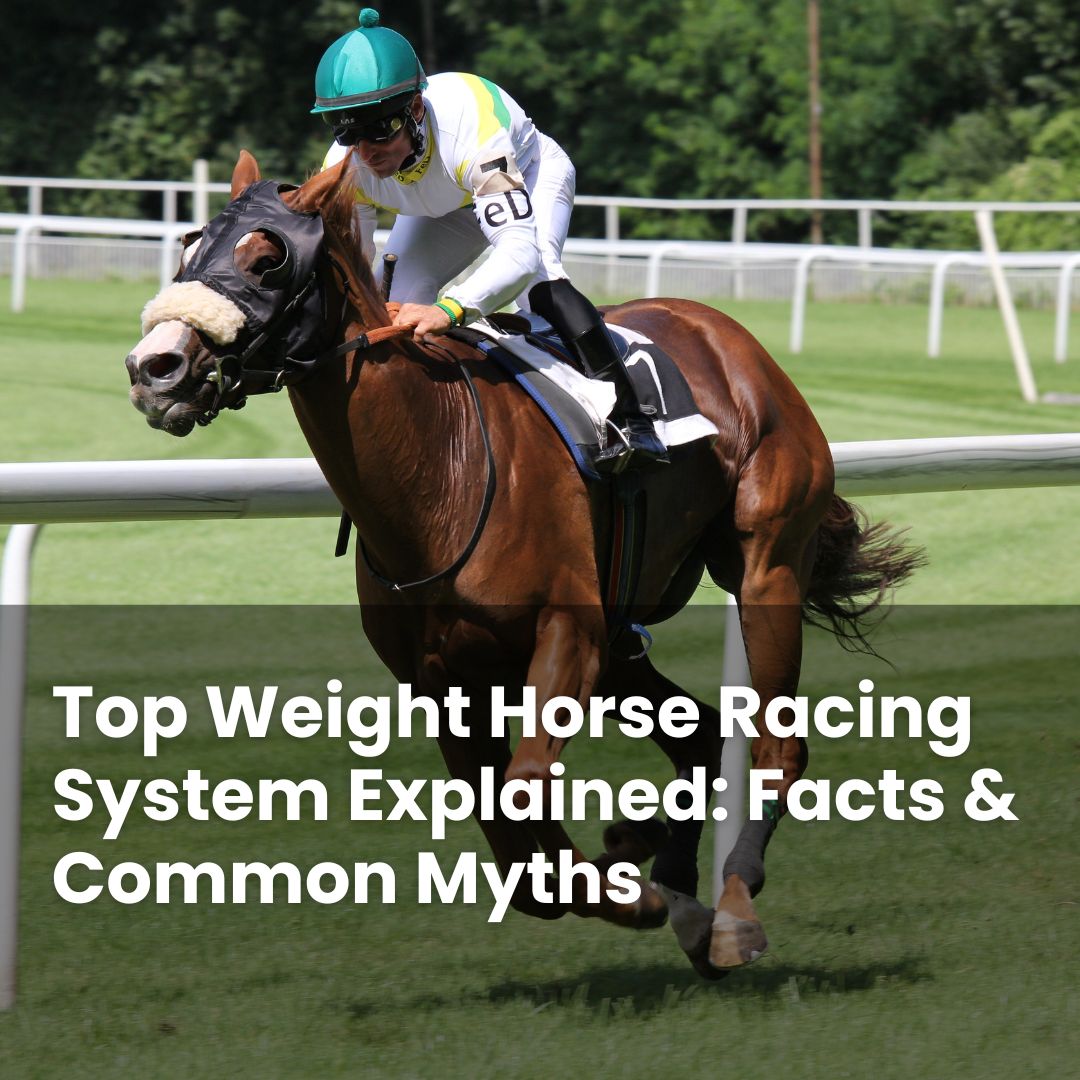
The idea of picking a winner at the races can feel exciting and a bit puzzling, especially when you hear terms like “top weight.” You might have seen people chat about it online or heard it mentioned at the track, but what does it really mean in practice?
In UK racing, “top weight” refers to the horse asked to carry the most weight in a handicap. That label sparks plenty of debate, with some giving it too much credit and others dismissing it without looking at the detail.
This guide cuts through the chatter. You will find what top weight actually tells you, how it is set, where common myths come from, and what the records suggest over time.
What Is The Top Weight System In Horse Racing?
In UK handicap races, each runner is assigned a different weight to carry so the race is more balanced. The horse carrying the most is the “top weight,” usually the one judged to have the strongest recent record compared with the rest of the field.
Some bettors treat this as a simple system, focusing mainly on the highest-weighted runner. The logic is straightforward: if officials have rated it best in the line-up, it could be a solid place to start when weighing up the race.
That assigned weight includes the jockey, saddle and, if needed, extra lead to reach the exact figure. You can see it on the racecard in stones and pounds, where the one at the top of the weights is clearly marked. The basic idea is to identify that runner, then assess whether its overall profile still stacks up given the burden it must carry.
As soon as you look at who sets those figures, the picture becomes clearer.
How Do Handicappers Decide Top Weight?
As noted above, handicaps work by spreading the weights to reflect ability. Handicappers use official ratings, updated after each run, to judge where each horse currently sits. The highest-rated horse among the entries is given top weight for that specific race, with the rest scaled down in line with their ratings.
Those ratings are shaped by several factors, including:
- Recent finishing positions and margins
- The strength of opposition faced
- Race conditions, such as going and pace
- Whether the run signalled improvement or a below-par effort
Because ratings move with results, the horse at the top of the weights is simply the best on figures in that field, not necessarily the best horse in training overall. Non-runners can also change the shape of a handicap at the final stage, sometimes altering who ends up on top weight.
With that in mind, the natural next question is how often the one carrying most weight actually comes home in front.

Discover The Best Online Casinos
Browse our list of top-recommended casino sites, read reviews from real players & be the first to get access to the latest casino bonuses
Does The Top Weight Win More Often Than Others?
In short, not consistently. The top weight is often a talented runner, but the handicap is designed to narrow any gap in ability. The added burden can make a close contest even tighter, so the highest-weighted horse does not usually win at a rate that outstrips the rest of the field.
Results vary by race set-up. In small fields over shorter trips, class can tell more readily if conditions suit. In big-field handicaps, traffic, pace and draw can matter just as much as raw ability. Over longer distances, the extra pounds are carried for longer and can have a more noticeable effect, especially if the ground is testing.
Other factors, such as current form, suitability to the track layout, and how the race is likely to be run, often shape the outcome more than the label of “top weight” on its own.
So, when does that label matter more, and when is it less telling?
Which Types Of Races Suit The Top Weight System Best
Top weight only applies in handicaps. In weight-for-age or maiden races, the same principle does not apply, so the concept is not relevant there.
Within handicaps, race type and class influence how the top-rated runner fares:
- Higher-class handicaps tend to bring fields closer together in ability, which can make the extra pounds feel less decisive. Class can still shine through if the set-up suits.
- Over jumps, the demands of jumping and longer distances can amplify the effect of weight, particularly on softer ground or on stamina-testing tracks.
- On the Flat, large summer fields and pacey races can shift the focus to draw, pace and track position. In those scenarios, the top of the weights may not be the key factor unless the runner also has a tactical advantage and arrives in peak form.
In every case, the label is a clue, not a conclusion. The context of the race tells you how strong that clue might be.
How To Test The Top Weight System?
A practical way to gauge how the idea holds up is to track a period of racing and compare what happens with what the market expected. Pick a run of meetings, note the top of the weights in each handicap, then record finishing positions, starting prices and any useful context such as race class, field size, ground and trip.
After a decent sample, you can see how often the highest-weighted runner wins or places relative to expectations. Comparing actual outcomes with the implied chances from starting prices offers a simple sense check. If the approach were consistently effective, you would expect it to outperform those implied probabilities over time, not just in isolated bursts.
Keeping the same notes across Flat and jumps, and across classes, helps reveal whether any patterns you spot are general or just tied to a specific niche.
If price and performance tend to line up, it suggests the market already understands what the weight tells us, which brings us neatly to reading the signals in the odds.
How To Read Market Odds And Top Weight Signals?
Odds reflect how bookmakers and bettors collectively rate each runner’s chance based on form, conditions and the weight carried. Shorter prices show stronger backing. If the top of the weights sits near the head of the market, the view is that it retains a strong chance despite the burden. If it is a bigger price, the crowd is signalling doubts, perhaps about ground, fitness, pace shape or suitability to the course.
Odds often move on the day as weather updates, draw positions, paddock appearance or stable information nudge opinion. A drift can mean conditions look less suitable than first thought, while support can suggest confidence that the set-up plays to a top-rated runner’s strengths.
Racecards clearly list the weights, so it is easy to identify who sits on top. The value lies in judging whether the price fairly reflects the balance between class and burden.
With the market view in mind, what does a wider look at long-term data say?
What Evidence Is There From Data And Studies?
Official data and independent analysis point in the same direction. The win rate of top-weighted runners in UK handicaps tends to sit close to, or a little below, the overall average for the field. That is consistent with the aim of handicapping, which is to bring runners closer together so that no single factor, including weight, dominates over time.
Broad reviews also show that backing the top of the weights blindly does not deliver a long-term edge once prices and overround are taken into account. Where top weights do well in a given spell, it often reflects short-term conditions aligning in their favour, not a repeatable pattern you can rely on across seasons.
The upshot is that the label helps describe the shape of a race, but it is not a shortcut to finding winners on its own.
Practical Pitfalls When Considering The Top Weight System
There are a few traps to avoid. Treating top weight as a green light can lead to overlooking context such as recent form, distance preferences, how the horse travels in its races, or whether the track and ground suit that style. In big fields, race shape and position can count for more than a small edge in ability. On tiring ground or over longer trips, the extra pounds may bite harder than expected.
Timing matters too. A horse can be handed a large burden after a standout run, then face different circumstances next time, such as a quick turnaround, a rise in trip, or a deeper race. Top-weighted runners can also attract extra attention, which sometimes shortens the price below what their chance truly warrants.
Used well, the top-of-the-weights tag is a useful signpost, not a system on its own. It is a starting point that needs to be weighed against the race set-up, the market view and the horse’s current condition. If you choose to get involved, set clear personal limits and keep it fun. Free, confidential advice and tools are available at BeGambleAware.org.