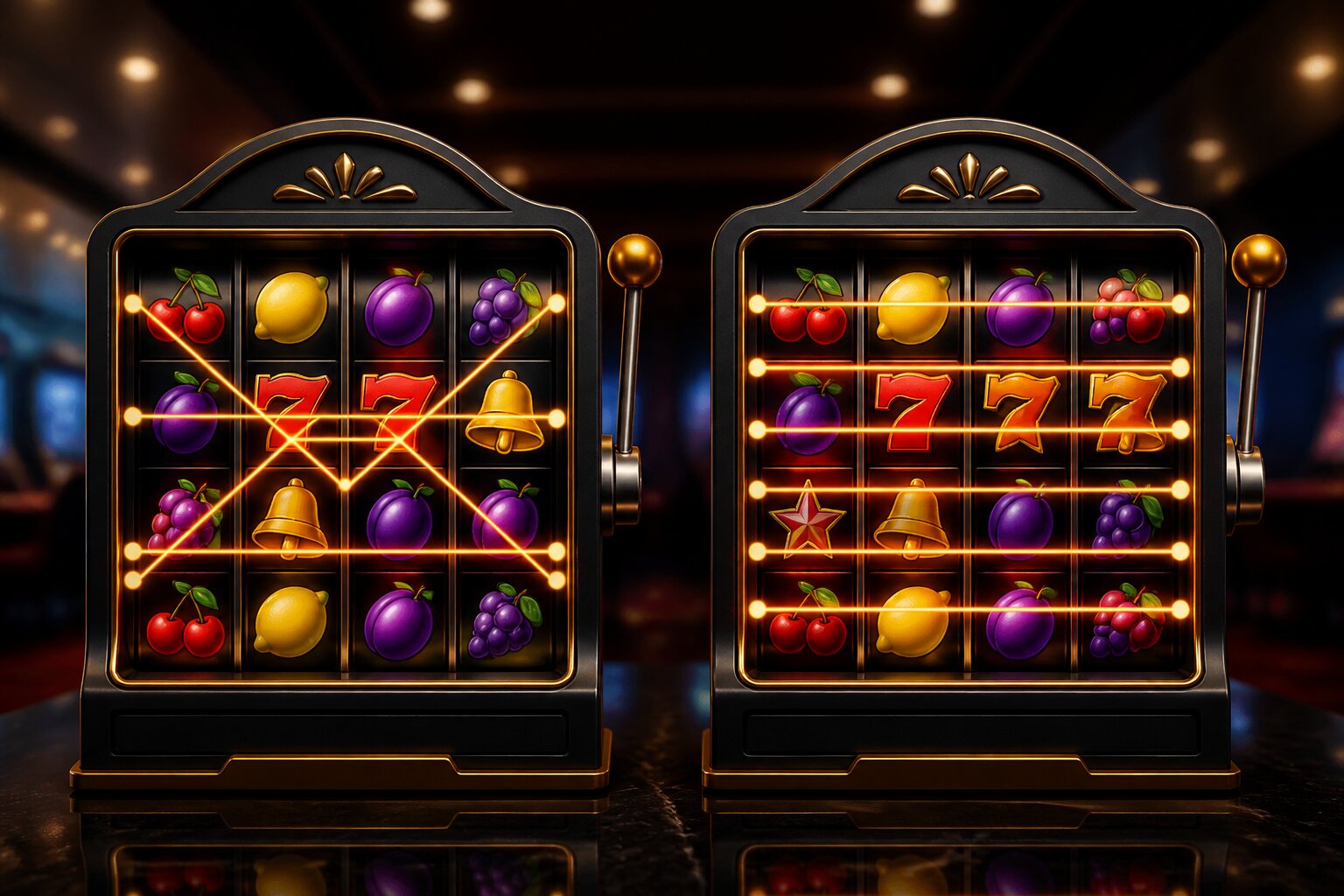
Choosing the right slot game can feel a bit overwhelming when confronted with terms like “ways” and “lines”. These features shape how symbols combine and how wins are paid, so a little clarity goes a long way.
This guide explains the mechanics, shows how payouts are calculated, and outlines the kinds of slots that use each system. It’s written to help you spot what suits your style and budget without drowning in jargon.
If you want practical detail rather than theory, read on — each section builds the picture so you can make informed choices about the games you try.
What Are Paylines and How Do They Work?
Paylines are fixed patterns across a slot’s reels. When matching symbols land along one of these patterns after a spin, the game awards a win according to its paytable. Patterns vary: some run straight across the reels, others zigzag or run diagonally, and more elaborate titles can use very complex shapes.
In many games, paylines are selectable: players choose how many lines to activate and the bet per line, so the total stake depends on those choices. Classic fruit machines often had a single central payline, while modern video slots may offer dozens or even hundreds. Because each payline is a fixed route, the rule for a win is simply whether a matching set of symbols appears along an active line.
Different slots present paylines in different ways — some show them visually on the reels, others describe them in the rules — so it helps to glance at the paytable before you play. Understanding how a game uses paylines also sets up a clearer view of the alternatives you’ll encounter next.
What Are Ways to Win in Slots?
Ways to win remove the concept of specific lines and instead pay whenever matching symbols appear on consecutive reels, typically starting from the leftmost reel. Rather than tracing a pattern, the game looks at symbol positions across the reels and counts every qualifying combination.
The number of ways depends on the reel layout. A common example is a five-reel game with three rows, which is often described as offering 243 ways to win: each symbol position on each reel can pair with positions on adjacent reels to form combinations. Some titles expand this dramatically, showing hundreds, thousands, or even more potential ways when they use variable-row or dynamic-reel mechanics.
Because all possible ways are active each spin, the stake is usually a single total bet rather than bets per line. This can simplify play, since there’s no line selection to manage, and it encourages frequent-looking combinations without the need to monitor patterns. The next section compares this structure directly with traditional paylines to highlight practical differences.

Discover The Best Online Casinos
Browse our list of top-recommended casino sites, read reviews from real players & be the first to get access to the latest casino bonuses
Major Differences Between Ways and Lines Slots
The core distinction is how a game recognises winning combinations. Lines slots require matches along pre-defined routes, so the pattern matters. Ways slots look for matches across consecutive reels and treat each relevant position as part of a wider combinational count.
Bet structure also differs. Lines slots commonly let players change the number of active paylines and adjust the stake per line, which gives granular control over how much is wagered each spin. Ways slots usually use a fixed stake that covers every possible combination, removing that layer of customisation.
Another practical difference is how wins visually present themselves: in lines slots a win aligns neatly along a marked path, while in ways slots wins can appear as collections of matching symbols across reels without a single visible line. Both designs are valid choices; the best fit depends on whether someone prefers control over lines or the streamlined feel of ways. Having covered that comparison, the next section explains how payouts are calculated in each format.
How Do Payouts Compare in Ways vs Lines Slots?
Payouts depend primarily on the paytable, the game’s RTP and variance, and the way wins are counted — not simply on whether a slot uses lines or ways. All modern regulated slots use certified random number generation to determine outcomes, so the way results are distributed is a matter of game design rather than type.
Understanding Payout Calculations
Lines slots compute winnings by applying the paytable values to the bet placed on the specific winning line. A symbol combination on an active payline multiplies the per-line stake by the relevant paytable multiplier to produce the payout.
With ways slots, the total stake covers every possible combination and the game calculates each qualifying symbol set against that single stake. Payouts are still guided by the paytable, but the arithmetic reflects the all-ways structure rather than per-line bets, which can make it easier to see how much a single spin risks and returns.
RTP — the theoretical percentage returned to players over time — is stated for each slot and applies regardless of whether the game uses lines or ways.
Volatility and Win Frequency
Volatility, sometimes called variance, describes how often a game tends to pay and how large those wins typically are. Low-volatility titles usually produce smaller, more frequent payouts, while high-volatility titles deliver larger payouts less often. Both lines and ways formats are available across the volatility spectrum, so a slot’s style does not dictate its payout rhythm by itself.
Game designers set paytable values and volatility independently of the mechanical choice between lines and ways, so comparing specific titles and their statistics is the best way to judge payout behaviour.
Types of Slots: Which Use Ways and Which Use Lines?
Traditional and classic-style slots tend to use paylines, often with only a handful of lines reflecting their simpler layouts. These games cater to players who like the tidy clarity of a limited number of patterns and an easily understood stake-per-line model.
Most modern video slots still use paylines, but with a much larger range — from around ten up to several hundred — and they often include adjustable line counts or advanced bonus features. Conversely, ways-to-win formats are most common in games with five or more reels and fixed-row structures, where the combinational maths can yield 243, 1,024 or even thousands of ways. Megaways-style titles use variable reel heights to push those totals much higher, offering a different kind of prize distribution on each spin.
Providers pick the system that best fits a game’s theme and mechanics, so titles within the same library can vary widely. If you prefer a quick way to see which games use each system, look at individual game pages where the format and mechanics are listed.
Are Ways or Lines Slots Better for UK Players?
Neither system is universally better; the right choice depends on what a player values. Lines slots offer more control over bet size because the stake can be split across selectable paylines, which appeals to those who like fine-tuning their wagers. Ways slots remove line-management and keep a consistent single bet, which some players find more straightforward.
Other considerations such as volatility, paytable structure and bonus features often matter more than whether a game uses lines or ways. Choose a game whose volatility matches how often and how big a win you’d prefer, and pick themes and features that make play enjoyable. Use licensed operators and the available account tools to keep play within limits; that practical approach protects both bankroll and experience.
Common Myths About Ways and Lines in Slots
There are a few persistent misunderstandings. One is that more paylines or more ways always mean a better chance of winning; while more combinations can increase the number of possible winning patterns on a single spin, they do not change the underlying probabilities established by the game’s RNG and paytable. Another myth is that one format inherently pays out more than the other — payout behaviour is determined by the specific paytable, RTP and volatility of each title rather than whether it uses lines or ways.
Claims that certain patterns or routines can “beat” slots are inaccurate: outcomes are generated independently for each spin and are not influenced by previous results or player choices about lines. For reliable information about a game’s rules, paytable and technical details, consult the game’s information screens where these elements are set out.
Choosing the Right Slot: Key Factors to Consider
Selecting a slot is about matching the game to personal preferences and practical limits. Start by looking at stake levels — minimum and maximum bets vary widely — and pick titles that fit comfortably within your budget. Next, consider volatility: decide whether you prefer more frequent smaller wins or the chance of larger but rarer payouts.
Entertainment features matter too: themes, bonus rounds and sound design shape how engaging a game feels, so choose those that hold attention. Finally, confirm the operator’s licence and the game’s fairness indicators before you play; licensed sites publish RTPs and other technical details that help you compare titles.
With budget, volatility and entertainment all considered, you’ll be equipped to choose slots that suit how you like to play and what you want to get from the experience.